Showing posts with label Edoardo Albert. Show all posts

Tuesday, October 22, 2013

HAPPY BIRTHDAY!

by Edoardo Albert

In honour of Penumbra’s second birthday, and without the slightest (well, hardly) intention to ingratiate myself with its editors, may I say that this is undoubtedly the friendliest and most professional magazine I’ve dealt with. Penumbra pays well, looks marvellous, responds quickly and, apart from publishing my stories, provides me with this free soapbox to advertise myself and my wares. What’s not to like? And, more importantly, long may it continue, particularly if it publishes more of my stories.

Dianna Gunn, intern par excellence, asked me to write something about what I’ve been up to since appearing in the magazine (since you ask, the Revolution and Exploration issues) and it just so happens that I have my first novel due out next March.
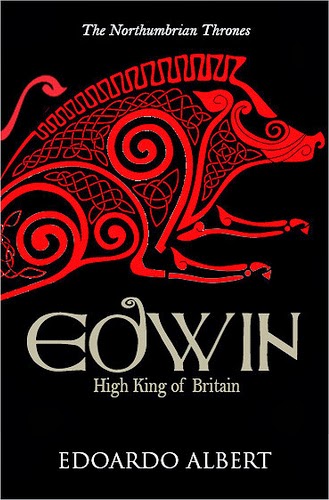
It’s only taken me thirty-two years to get to this stage! Anyway, Edwin: High King of Britain was a result of the research that went into writing my book, Northumbria: the Lost Kingdom, on the history and archaeology of one of the key Dark Ages kingdoms of England (although, of course, England didn’t actually exist then). The story of the three successive Northumbrian kings whom the Venerable Bede accords the title bretwalda – that is High King of Britain – seemed so extraordinary I was astonished that nobody had written about them before. So I decided to.

One of the advantages of doing things this way round was that I had already done most of the historical research necessary – it was just a matter of trying to bring it all to life. Hopefully I have done so, it would be a grave discourtesy to some extraordinary but all but forgotten people if I haven’t. The book will be published by Lion Fiction in March. The publishers, spotting a link, have given the trilogy the overarching title of The Northumbrian Thrones but in truth, there really was something very like a game for thrones going on in the bloody, violent but extraordinarily creative kingdoms of seventh-century Britain. The foundations of England were laid, amid historical darkness, in a time when the only certainty for a king was a violent death. And yet, perhaps because of the very precariousness of the times, these men and women created things, such as the Lindisfarne Gospels and the Sutton Hoo jewellery, of quite extraordinary beauty. While in some ways the kings of the Early Medieval Period (the preferred academic term today) were like Mafia dons, enforcing protection rackets on their subjects, yet the culture they created and their sensitivity to language were as far removed from the profane and profanity filled life of a John Gotti as it is possible to be.

To do such times and such people justice is no small task. I can hardly hope to have succeeded, but at least I hope not to have failed.

Edoardo Albert is, on paper at least, a surprisingly exotic creature: Italian, Sinhala and Tamil by background, he grew up in London among the polyglot children of immigrants (it was only when he went to university that he actually got to know any English people). He avers that he once reduced a reader to helpless, hysterical laughter. Unfortunately, the piece that did so was a lonely-hearts ad.

Find Edoardo Albert’s books (he’s particularly proud of Northumbria: The Lost Kingdom) and stories via his website although the lonely-hearts ad will not be making an appearance in the foreseeable future. Connect with him through his blog, Twitter or Facebook.

Thursday, August 1, 2013

When Animals Speak

by Edoardo Albert

I have always been vaguely surprised that animals don’t speak. Maybe I am unusual in this, but I believe my reaction, on being addressed by a cat or spoken to by a dog, would more likely be relief that I had finally been let in on the conversation rather than amazement at their speaking. And it’s not just cats and dogs either – the last few, sweaty hot nights have seen me sleeping with windows thrown wide, only to be roused from the fitful slumber of the early hours by the extraordinary racket set up by the birds at four in the morning. There’s definitely something going on in the avian world that they keep to themselves, relying on slugabed humans not being awake to hear.

Nor would I stop at animals, be they feathered or furred. Who has walked at twilight through a wood, when the wind gets up as the sun goes down, and heard the creak of timber and the hiss of leaf and not thought, with a twinge of mingled excitement and fear, that the trees are speaking of the day. Although the idea of the music of the spheres now seems ridiculous, how much is this down to the haze of light saturating our cities and excluding all but the brightest stars from a sky that is no longer black but a neon grey. The city nightscape is a dull, closed in bowl. But on those occasions when I have been beyond the reach of artificial light, and innumerable stars have arched across the sky and the night has been so black I could not see my own feet upon the road, then the idea of crystal music reverberating around the heavens seems considerably less outmoded. I suppose the distant receding echo of the creation that suffuses, well, everything is the drone over which the stars and galaxies weave their harmony. Honestly, sometimes it seems that all creation is engaged in one giant conversation from which we alone are excluded. ‘For everything that lives is holy’, as Blake said, to which we might add it’s busy talking too!

Of course, the question is why we are excluded from the conversation of creation. In CS Lewis’s Space Trilogy, the Earth, Thulcandra, is called the silent planet due to the revolt of its presiding spirit against the presiding spirits of the other planets. However, that does not really address why we are excluded from the conversations of the creatures that share our world. Moving from biology and astronomy to mythology and folklore, stories and legends from throughout the world and almost all eras attest to creatures talking to us: elves, dwarves, djinn and devas, the list is long, the conversation not always edifying – interviewing a vampire only recently becoming something desirable – but for most of human history it has been ongoing. Until now. The last century or so has seen a trickling away of such stories. There has been the odd, overly intimate, encounter with aliens, but the beings whose worlds used to intersect with ours have retreated. We live alone in a world gone silent. The question is why.

Having dragged you this far, it would be a pretty poor show if I didn’t at least attempt an answer, so here goes. The world has not fallen silent. The animals and birds speak, the creatures of legend and myth walk their shadow paths, but we are too preoccupied, too caught up in our own endless chatter, to hear or to see. As we have been able to talk more, through letter, telephone, television and now, ceaselessly, online, all other conversations have been drowned out. The human party has grown too loud and rowdy to allow anything else a voice. It is indeed a wonder of our age that we should be able to talk across the world but in doing so we, necessarily, tune out everything else. Returning to our human party metaphor, talking to someone there requires the suppression of everything else: concentration and exclusion. Our whole world is a cacophony of competing human voices. To hear any of them – to keep from going mad – we have to concentrate and exclude. Is it any wonder then that we can no longer hear other voices, and tune in to different conversations?

So, and pace the wonderful people at Penumbra, my suggestion is this: switch off your computer (or phone, or iPad). Turn off the television. And listen. You never know what you might hear. There are all sorts of conversations going on around us all the time. Falling silent ourselves allows us to eavesdrop on them. And, who knows, if we listen, quietly, patiently, politely, they might, in time, include us in the conversation again.

This is the road less traveled in human history: the one taken by the quiet ones, the hermits, the monks, the people who see the overgrown path leading up to a cleft in the hill and take it, the ones who shut the door against the noise of the city and listen to their walls breathe. Uncomfortable, uncomforted people, garnering little sympathy in our compulsively sociable world. There is no guarantee in such a journey. The path might peter out, the walls become a prison, but still and still…

Listen. Close your eyes. Listen.

Who knows what you might hear?

The responses to Edoardo Albert’s work rather prove what he argues. The stories, the books, the articles, have drawn some compliments, but the best response ever, which saw a friend rolling on the ground, helpless with laughter, was a lonely-hearts ad. It was probably the bit about tickling the belly of a wolf that did it.

Find Edoardo Albert’s books (he’s particularly proud of Northumbria: The Lost Kingdom) and stories via his website although the lonely-hearts ad will not be making an appearance in the foreseeable future. Connect with him through his blog, Twitter or Facebook.

Thursday, December 27, 2012

How It All Began

Today, we host a short Q&A with Randy Lindsay, "Not Fragile", and Edorado Albert, "Time Hoppers". Both talented authors and their work appeared in the November issue of Penumbra eMag.

Randy, when did you first realize you wanted to pursue writing as a career rather than a hobby?

It’s entirely possible that I live in a fantasy world of my own devising. Whenever a great idea pops into my head, I am convinced that there is a market for it – somewhere. So, it isn’t as much a matter of when I decided to pursue a writing career as it is a question of when I decided to start writing.

That happened while I was reading a book. I happened to disagree with many of the story telling decisions that the author made and discussed with one of my friends how I would have written it. When I finished, I thought I had a pretty good alternate story going on and started my journey as an author.

Several years of learning the craft and dozens of failed stories later I decided it was time to get serious about writing as a career. That would have been about three years ago. I started attending conferences to network within the industry. I started my blog so it could serve as a media platform once my stories started to be published. And I started submitting my stories.

What I find most interesting is that while it took a while to get here, things are really popping for me now. Right on the heels of my sale to Penumbra I had three more stories accepted for publication and will be coming out in 2013. I appreciate Penumbra opening the flood gates for writing career.

Edoardo, when did you first realize you wanted to pursue writing as a career rather than a hobby?

The first thing I can remember wanting to be was a paleontologist. When I realised that, unfortunately and despite the hopes raised by Arthur Conan Doyle's The Lost World, all the dinosaurs really were dead, I switched to zoology. Then, an astronaut, a physicist, the President of the United States (abandoned when I found out that, not being American, I couldn't actually be president), an engineer and various other ideas in a rather dizzying succession. However, the only constant through all of this was reading.

I read - all the time. I even got told off as a seven-year-old for sneaking a book into a lesson and reading it under the desk because I couldn't wait to find out what happened (it was one of Enid Blyton's Famous Five books and to this day I will hear no calumny against her). So, in the end, I realised there was a thread through my life: words. And I began to pursue them. It has, though, been a long, slow slog - some thirty (30!) years of learning, being rejected, learning some more, making connections, getting rejected, and, hopefully, learning even more.

Randy Lindsay worked in the Hobby-Game industry for several years as a game designer and is now a stay-at-home dad looking to establish himself as an author. He writes Fantasy, SF, and is working on a Murder-Comedy. His short fiction has appeared in City of the Gods anthology and now Penumbra with upcoming stories in the Once Upon An Apocalypse anthology and the second City of the Gods anthology.

Learn more about Randy on his website and blog where he also writes on topics related to the craft of writing and offers movie reviews.

The responses to Edoardo Albert’s work rather prove what he argues. The stories, the books, the articles, have drawn some compliments, but the best response ever, which saw a friend rolling on the ground, helpless with laughter, was a lonely-hearts ad. It was probably the bit about tickling the belly of a wolf that did it.

Find Edoardo Albert’s books (he’s particularly proud of Northumbria: The Lost Kingdom which has just been published) and stories via his website although the lonely-hearts ad will not be making an appearance in the foreseeable future). Connect with him through his blog, Twitter or Facebook.

Tuesday, November 20, 2012

Where Is the Humour?

by Edoardo Albert

The future, it appears, has no jokes. Nor, for that matter, does the urban present, even if it is filled with glittery vampires. For some reason, speculative fiction appears to be almost completely humourless – think of the number of magazines, ezines, fanzines and geezines that advertise themselves as ‘dark’, ‘darker’ or ‘so bloody morbid we’re invisible at night’. Why is this? True, the old grandmasters of speculative fiction that I grew up reading, men like Robert Heinlein, Arthur Clarke and Isaac Asimov, were more concerned with imagining and, dare I say, propagandising the future than populating it with jokes (although anyone reading ‘The Number of the Beast’ would have to assume that Heinlein, at least, had a sense of humour since the alternative, that he seriously means this, is just too awful to contemplate). But surely now – when we live in a world with all the trappings of the wildest science fiction future in an everyday iPhone – it’s time to admit that the future is here and it’s completely and utterly ridiculous. I mean, what would the Futurians have made of a future that achieved technological miracles and used them to turn Paris Hilton into the most famous person on the planet?

In fact, all the prophets and soothsayers were wrong. Take George Orwell for example. Although he was correct in much, he saw the future as a boot stamping on a human face forever. Well, the future turned out to be a human face gurning forever. As such, maybe the reason there’s so few jokes in speculative fiction is because it’s pretty well impossible to top what’s actually out there. Imagine the most extreme ad absurdum you can, and someone will be offering it on eBay. After all, one young woman just auctioned her virginity for $780,000 and justifies it as a career move. You really couldn’t make it up.

Then why should you? The world is the most wonderful resource for the writer of the absurd and it’s there to be mined: after all, what could be sillier than sex, money and politics?

The temptation, of course, is to conclude that because we are absurd, as a species and a civilisation, then everything is. But that, it turns out, is a conclusion too far – there is nothing absurd in nature although there is much that is strange and grotesque. Absurdity is a human specific attribute, and one that grows more pronounced the greater our powers become. “Ye shall be as gods,” was the promise, and we are, wielding powers undreamed of, sufficient to make a paradise on earth. But, instead, we have the Shopping Channel. It’s an object lesson in unintended consequences. We could imagine Jehovah, standing by the gates of Eden, asking, “So how’s that god business shaping up for you?” It’s the job of the writer to answer, “Er, not so well.”

Edorado Albert's story Time Hoppers is featured in the November issue of Penumbra EMag.

The responses to Edoardo Albert’s work rather prove what he argues above. The stories, the books, the articles, have drawn some compliments, but the best response ever, which saw a friend rolling on the ground, helpless with laughter, was a lonely-hearts ad. It was probably the bit about tickling the belly of a wolf that did it.

Find Edoardo Albert’s books (he’s particularly proud of Northumbria: The Lost Kingdom which has just been published) and stories via his website although the lonely-hearts ad will not be making an appearance in the foreseeable future). Connect with him through his blog, Twitter or Facebook.