Showing posts with label Dianna L. Gunn. Show all posts

Tuesday, November 5, 2013

Two Years of Penumbra

by Dianna L. Gunn

Two years ago I sent an email to a woman named Celina asking if I could intern with her brand new publishing company. To be honest, as a writer with only a couple non-fiction clips and still in high school, I didn't expect to hear back. I was happily surprised when she invited me to become an intern, and happier still when I was moved from Musa Publishing to Penumbra EMag. Soon enough I was put in charge of this blog, and through it I've had the opportunity to work with many great authors.

Over the two years since my internship began, many things have changed. Musa has grown exponentially, publishing the works of Gary K. Wolf and the late great Homer Eon Flint. The website has been made over and we've published hundreds of books. This little publisher has grown to be a massive force that attracts some of speculative fiction's most renowned authors away from the Big Six. We have proven that an ebook publisher, who's completely open and honest with its authors, can succeed and that we can publish several good books in a single month.

I have also changed. I graduated high school, but I'm staying for an extra semester to help launch some massive writing projects. I have fallen in and out of love. I have become a woman in the eyes of the law, and I am now preparing to move out on my own for the first time. I've experimented with freelance writing and decided I'd rather have a normal job for now. I've written and edited several books of my own, and I am slowly gearing up to start submitting my first novel.

The literary world has changed, too. Ebooks are on the rise. J.K. Rowling is writing something other than Harry Potter. One of the most brilliant minds of the last century, Ray Bradbury, has been lost to the world.

As the third year of Penumbra begins it is time to celebrate what we've accomplished so far and the great successes soon to come. As such, we'll have different authors from this past year make an appearance here to talk about speculative fiction and Penumbra EMag. I hope you'll enjoy reading these posts as much as I've enjoyed working with these authors.

Dianna L. Gunn is a young Canadian fiction writer who specializes in dark fantasy. She also writes poetry, generally dark, which is her way of dealing with life. This insightful author hosts a website covering every aspect of fiction writing and interviews with noted guest authors.

Learn more about Dianna L. Gunn on her website and follow her on Twitter.

Tuesday, October 22, 2013

HAPPY BIRTHDAY!

by Edoardo Albert

In honour of Penumbra’s second birthday, and without the slightest (well, hardly) intention to ingratiate myself with its editors, may I say that this is undoubtedly the friendliest and most professional magazine I’ve dealt with. Penumbra pays well, looks marvellous, responds quickly and, apart from publishing my stories, provides me with this free soapbox to advertise myself and my wares. What’s not to like? And, more importantly, long may it continue, particularly if it publishes more of my stories.

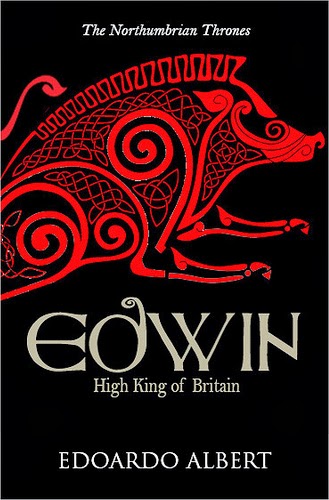
Dianna Gunn, intern par excellence, asked me to write something about what I’ve been up to since appearing in the magazine (since you ask, the Revolution and Exploration issues) and it just so happens that I have my first novel due out next March.

It’s only taken me thirty-two years to get to this stage! Anyway, Edwin: High King of Britain was a result of the research that went into writing my book, Northumbria: the Lost Kingdom, on the history and archaeology of one of the key Dark Ages kingdoms of England (although, of course, England didn’t actually exist then). The story of the three successive Northumbrian kings whom the Venerable Bede accords the title bretwalda – that is High King of Britain – seemed so extraordinary I was astonished that nobody had written about them before. So I decided to.

One of the advantages of doing things this way round was that I had already done most of the historical research necessary – it was just a matter of trying to bring it all to life. Hopefully I have done so, it would be a grave discourtesy to some extraordinary but all but forgotten people if I haven’t. The book will be published by Lion Fiction in March. The publishers, spotting a link, have given the trilogy the overarching title of The Northumbrian Thrones but in truth, there really was something very like a game for thrones going on in the bloody, violent but extraordinarily creative kingdoms of seventh-century Britain. The foundations of England were laid, amid historical darkness, in a time when the only certainty for a king was a violent death. And yet, perhaps because of the very precariousness of the times, these men and women created things, such as the Lindisfarne Gospels and the Sutton Hoo jewellery, of quite extraordinary beauty. While in some ways the kings of the Early Medieval Period (the preferred academic term today) were like Mafia dons, enforcing protection rackets on their subjects, yet the culture they created and their sensitivity to language were as far removed from the profane and profanity filled life of a John Gotti as it is possible to be.

To do such times and such people justice is no small task. I can hardly hope to have succeeded, but at least I hope not to have failed.

Edoardo Albert is, on paper at least, a surprisingly exotic creature: Italian, Sinhala and Tamil by background, he grew up in London among the polyglot children of immigrants (it was only when he went to university that he actually got to know any English people). He avers that he once reduced a reader to helpless, hysterical laughter. Unfortunately, the piece that did so was a lonely-hearts ad.

Find Edoardo Albert’s books (he’s particularly proud of Northumbria: The Lost Kingdom) and stories via his website although the lonely-hearts ad will not be making an appearance in the foreseeable future. Connect with him through his blog, Twitter or Facebook.

Tuesday, February 19, 2013

The Psychology of Zombies

by Dianna L. Gunn

I've never been particularly fond of zombies. I mean, I've watched most of the Resident Evil movies and several other zombie films, but I've never quite understood the fascination. Zombies are, frankly, gross and unpleasant.


Personally, I prefer a classier villain. Take, for instance, vampires. Vampires are usually beautiful creatures that retain all their human intelligence. Anybody can fall for a vampire. They seem like people.

On the other hand, zombies are pretty distinctive creatures. The rotting flesh, the smell, the grunting rather than speech. Everyone I've ever met is able to recognize a zombie.

Common writing advice will tell you that people prefer villains they can connect to. They want to understand your villain. So why, then, do people enjoy zombie films so much?

Since people are too intelligent to really connect to villains who only speak in grunts, we must bring the appeal of zombies to a baser level: fear. Zombies are obviously frightening, and some people really love stories that make them shiver.

But what is it about zombies that makes them so frightening? Is it merely the fact that they're trying to eat human brains? Is it the fear of human deterioration? Or is it something deeper—say, the fear that we're becoming mindless drones controlled by capitalism? Perhaps it is a fear of the mob mentality.

I've considered several possibilities but so far there's only one certainty: people love zombie stories and I'll probably never know why. And while I'll never understand it, I do know one thing: people who like zombies will love this month's issue of Penumbra.

Dianna L. Gunn is a young Canadian fiction writer who specializes in dark fantasy. She also writes poetry, generally dark, which is her way of dealing with life. This insightful author hosts a website covering every aspect of fiction writing and interviews with noted guest authors.

Learn more about Dianna L. Gunn on her website and follow her on Twitter.

Thursday, January 31, 2013

Ray Bradbury Issue Up for Review

by Dianna L. Gunn

Have you heard of Tangent Online? They are the ultimate review magazine for fans of speculative fiction, critiquing everything SF/F they can acquire. Tangent Online is also one of the few publications to review both electronic and print magazines. We are fortunate that they have reviewed several issues of Penumbra.

Even though I love this issue of Penumbra, I was blown away by Tangent Online's stellar review of our January Ray Bradbury issue. It's one thing to gush about a magazine I've actually worked on, but it's more thrilling to see a third party reviewer with no obligation enjoy Penumbra, too.

So if you've considered the Ray Bradbury issue but want to know more about it, check out this review--and if you're already decided, you can purchase a copy here.

Tuesday, January 8, 2013

The Legacy of a Writer

by Dianna L. Gunn

Ordinary people will be lucky to be remembered by their grandchildren and great-grandchildren after they die. Great artists and writers, who often began as ordinary people, are luckier: they will be remembered by their fans and their fans' children. Some are even remembered by the whole world—I mean, who hasn't heard of Tolkien or Da Vinci?

One writer likely to be remembered for generations—and who has already touched lives in multiple generations—is Ray Bradbury. Even I, who have read only a small portion of his large body of work, will remember him until the day I die. Every member of my family loves books, and both my grandmother and my mother have greatly enjoyed Ray Bradbury's fiction.

There is a long tradition among writers of honouring our greats by writing stories inspired by them and articles about them. The honours bestowed upon these masters of our craft can take many forms. Some are honoured with books of essays about their work. Others are honoured by a commemorative edition of their book with an intro by a current writer. Some have contests run in their name. Others are honoured by a themed issue of a magazine, such as this issue of Penumbra. The greatest authors get several of these honours.

This is the writer's dream: to be remembered, to make their mark on the world, to inspire others. The loss of Ray Bradbury in June of last year was enormously sad to all fans of speculative fiction, but his work shall live on, keeping his memory alive. So it is that no great writer truly dies: they live on in the hearts of others for hundreds of years. While it can be said that our lost loved ones live on in our hearts, when we die, their memories are usually gone for good—but great writers and artists live much longer in just the same way.

As a writer myself, I can only hope to be remembered half so well, that one day I will be honoured as I honour Ray Bradbury today.

Dianna L. Gunn is a young Canadian fiction writer who specializes in dark fantasy. She also writes poetry, generally dark, which is her way of dealing with life. This insightful author hosts a website covering every aspect of fiction writing and interviews with noted guest authors.

Learn more about Dianna L. Gunn on her website and follow her on Twitter.
Thursday, December 20, 2012

What's On Your Reading List for 2013?

by Dianna L. Gunn

The new year is almost upon us, and as 2012 comes to a close many people are re-examining their lives and creating lists of "resolutions"--things they want to do to make their lives better in 2013.

I have my own list of "resolutions", but it isn't my only list for 2013. I also have another kind of list: a reading list for the year ahead. It consists of all kinds of stories, from speculative short fiction to novels in all genres. Some are books I've been asked to review on my blog, others are books by friends, still others are on the list because I believe I can learn from them. A few are on the list entirely for pleasure.

One of the things on my reading list is actually twelve things—the twelve issues of Penumbra we'll be producing next year. And I'm not just saying that because I work here—I'm planning to read the next several issues of Penumbra because I've enjoyed every single issue we've produced so far. Our editorial committee selects only the best stories, and our columns by Lori Basiewicz and Richard White are not to be missed. Most issues come with an author interview and feature article to boot, and if you're interested in finding out more about our deal with Gary K. Wolf for Who Wacked Roger Rabbit, the next couple of issues are not to be missed.

Whatever else is on your reading list for 2013, I hope you'll be adding twelve issues of Penumbra. A year's subscription only costs $36—a low price when compared to other speculative fiction magazines, made possible by our electronic model and low overhead—and if you purchase your subscription by January first, you'll get a second one free. What better way to celebrate the holidays than by purchasing matching subscriptions for you and a loved one so you can share stories all year?

To purchase your subscription now, please click HERE.

Dianna L. Gunn is a young Canadian fiction writer who specializes in dark fantasy. She also writes poetry, generally dark, which is her way of dealing with life. This insightful author hosts a website covering every aspect of fiction writing and interviews with noted guest authors.

Learn more about Dianna L. Gunn on her website and follow her on Twitter.

Tuesday, December 11, 2012

My Definition of Utopia

by Dianna L. Gunn

When we ran the Dystopia issue back in July, I wrote a post entitled Utopia Vs. Dystopia. As a final note I said that everyone's idea of utopia is different, so today I'd like to tell you about my vision of utopia.

In my utopia, we would have found an infinitely renewable source of electricity. This way, we could keep things like the internet functional without ruining our planet.

In my utopia, money wouldn't exist. Instead, regardless of what job they did, children, students and everyone employed would have shelter and food and other crucial items would be shared freely. What jobs people did would be based on their passion, rather than on what education they could afford or on race, age or gender. This would eliminate both poverty and hunger.

In my utopia, it would be easy and acceptable to plan your families, with birth control and contraception being freely provided. This way, nobody would have children they didn't want, meaning all children would be well loved.

In my utopia, sickness would never put someone into debt, but more importantly, terminally ill people would be able to choose when they die. Nobody would be forced to live in a hospital bed attached to twenty machines. People would instead choose the time and place of their death, so that they might die happy and with dignity.

In my utopia, there would be no 1%. Instead there would only be 100%, with all people on an equal footing, recognizing that everyone's contribution to society is important—after all, how well do you think teachers would teach if they had to clean the schools too? How well do you think scientists would do if they had nobody to teach them the periodic table? Every job is important to keep the system running, and in my utopia, they would acknowledge that.

My utopia would be a society that matched my values, focusing on the well being of its people rather than their efficiency or money. It is based upon my ideals. Some people's idea of utopia will be the same as mine. Others will have a slightly different or even completely different idea of utopia based on their own beliefs—and that variety of belief is just what makes humans so great.

So now I ask you to think: what does your utopia look like?

Dianna L. Gunn is a young Canadian fiction writer who specializes in dark fantasy. She also writes poetry, generally dark, which is her way of dealing with life. This insightful author hosts a website covering every aspect of fiction writing and interviews with noted guest authors.

Learn more about Dianna L. Gunn on her website and follow her on Twitter.

Tuesday, November 27, 2012

On November, Nanowrimo, and Exploration

by Dianna L. Gunn

In spite of the rain and cold keeping me indoors, when I heard that November's Penumbra issue was going to have an exploration theme, I thought it was perfect. Not because American Thanksgiving celebrates taking land from the natives or because of any historical feat, but because November is the month of Nanowrimo.

For those of you who don't know, Nanowrimo is an annual challenge to write 50, 000 words of fiction in a month. The motto of quantity over quality along with the large community and tight deadline forces you to just write, without holding anything back. It's a great way to discover whether or not you actually have a novel in you. Along the way you'll learn more about yourself and about writing than you thought possible, even though you probably won't want to look at the draft when you're done with it.

Even after eight years, I consider every Nanowrimo an exploration. Each year I start with a story—usually the bare bones of one—and explore all its avenues. I travel through the world I've created for this year's novel, learning everything there is to know. I discover my character's darkest secrets and their greatest joys.

Year after year, I also discover things about myself. I've discovered that, if left alone for a month with no ability to go outside and only a computer to keep me company, I can write 300, 000 words in 30 days. I've discovered that this behaviour leads to tendonitis, which I still struggle with. I've also discovered that if I'm actually trying to do well in school, I can't accomplish anywhere near that word count.

Similarly, in one year of working at Penumbra I've learned a lot. I've learned what it takes to build a successful magazine, how difficult it is to manage a blog when you're relying primarily on other people, and how awesome it feels to see the slow but steady climb of readers. I've also learned that even I have a burn out point, and that as much as I want to be superwoman, sometimes I have to take a step back and refuse extra duties.

This November, I planned to discover a whole new world with my writing. I'm also hoping to find new ways to make Penumbra shine and to bring our blog—and the eMagazine itself—to new audiences all over the world.

What did you hope to discover this November?

Dianna L. Gunn is a young Canadian fiction writer who specializes in dark fantasy. She also writes poetry, generally dark, which is her way of dealing with life. This insightful author hosts a website covering every aspect of fiction writing and interviews with noted guest authors.

Learn more about Dianna L. Gunn on her website and follow her on Twitter.

Tuesday, October 16, 2012

One Year of Penumbra

by Dianna L. Gunn

When I emailed Celina Summers to ask about an internship with Penumbra last September, I didn't expect a response. When she invited me to join the Musa team, I expected six months of reading submissions then be sent on my way.

My expectations couldn't have been more wrong. At the end of October I was assigned to work with a team of interns on creating the third issue of Penumbra. My duties included editing and interviewing Homer Eon Flint's granddaughter and Musa author Vella Munn. I had great fun working with the other interns—and I am not a fan of group projects—and was thrilled with our December issue.

Since then, I've worked on several issues of Penumbra and interviewed a number of authors—including William Horwood, a hero on my personal bookshelf. I've also managed the blog, corresponding with authors to round up posts. I've even helped update Penumbra's Facebook and Twitter.

When I signed up as an intern, I didn't expect any of these opportunities. Sure, it's ended up being more complicated than what I originally signed up for, but it's also been a great learning experience. I've learned so much about writing, publishing, and how much work really goes into your favourite magazines. Even better, I've had the opportunity to meet and interview dozens of authors—both Penumbra authors and authors from each of Musa's imprints.

But what really stands out about working with the Penumbra team and the Musa staff isn't the lessons I've learned or the opportunities I've been given. It's the feeling that I've been brought into a big, happy family. Big staff meetings don't stress me out—instead, I look forward talking to the team and working to create our next issue. We've all been brought together by a love of fiction and a belief in the things Musa and Penumbra stand for—turning writers into authors, providing readers with great fiction, and paying our authors professional rates while keeping our fiction affordable.

I've had to take a step back from the actual Penumbra issues due to other commitments, but I'm still here working in the background. I've watched this magazine grow so much; I love each issue more than the last. I'm proud of what we do here at Penumbra and I hope to stay with this emagazine for years—both because I love the emagazine and because I love the people behind it.

Dianna L. Gunn is a young Canadian fiction writer who specializes in dark fantasy. She also writes poetry, generally dark, which is her way of dealing with life. This insightful author hosts a website covering every aspect of fiction writing and interviews with noted guest authors.

Learn more about Dianna L. Gunn on her website and follow her on Twitter.

Thursday, July 12, 2012

Utopian Vs. Dystopian: Two Forms of Great Fiction

by Dianna L. Gunn

If you've spent much time at all reading and studying speculative fiction, and maybe even if you haven't, you've probably heard the terms 'utopian' and 'dystopian' a lot, particularly in reference to science fiction novels. There's a good chance you've even got a vague idea of what each word means—but have you ever thought about it more deeply?

Let's take a look at the original words, armed with a trusty 1980 Oxford American Dictionary:

Utopia 1. An imaginary place or state of things where everything is perfect.

We'll stick with this definition, as it's the one most commonly applied to science fiction.

Interestingly enough, my edition of the Oxford doesn't contain dystopia, so for this one I've turned to dictionary.com:

Dystopia 1. A society characterized by human misery, as squalor, disease, and overcrowding.

Seems pretty clear cut, right? A utopian science fiction novel would obviously be one set in a place where all the world's problems have been fixed, whereas a dystopian science fiction novel would be one where the world has fallen into decline.

It both is and isn't as simple as that. Many science fiction novels blur the lines between utopia and dystopia. In The Time Machine by H.G. Wells, you first think the future society is a utopia where everyone's peaceful and has enough to eat, only to discover its darkest secrets and that it's closer to a dystopia.

Beyond that, everyone's definition of a utopia—or a dystopia—is different. Take Woman on the Edge of Time by Marge Piercy, in which a welfare-dependent Mexican woman is shown a future where men and women take equal part in the work, massive cities have given way to smaller townships, and food, along with other resources, are shared communally. For me and many others, this is a utopian future.

But that's not all Connie, the hero of Woman on the Edge of Time sees. She also sees a future in which humanity's retreated to metal homes and space stations, where the world is unlivable with food marked-up and everything else is created and delivered by machines. For Connie—and for me—this is a terrifying future—but it isn't terrifying to everyone.

Some books by genre are defined as utopian or dystopian, but this is certainly a case of beauty is in the eye of the beholder. Sure, most people are horrified by the extreme surveillance of Nineteen Eighty-Four or the mutation of humanity almost beyond recognition in The Time Machine, but some will always see it differently. Each of us dreams of a different future—my vision of utopia, where everyone's equal and we've eliminated capitalism, might just be your vision of dystopia.

Dianna L. Gunn is a young Canadian fiction writer who specializes in dark fantasy. She also writes poetry, generally dark, which is her way of dealing with life. This insightful author hosts a website covering every aspect of fiction writing and interviews with noted guest authors.

Learn more about Dianna L. Gunn on her website and follow her on Twitter.

Saturday, March 3, 2012

Dr. Seuss and Speculative Fiction

Dr. Seuss and Speculative Fiction
by Dianna L. Gunn


For some reason when I think of kids books, I rarely define them by genre. In my head, they're all just kids books. Of course, books for kids are sort of their own genre, but as with YA, all the usual genres exist in these books.

I came to all of these realizations when I was asked to write about Dr. Seuss and speculative fiction. At first I was confused. How is Dr. Seuss a speculative fiction writer? The question bounced around in my head for a few hours, and then I realized the answer was right in front of me.

Dr. Seuss uses lots of speculative fiction elements. His stories are so far out there that it's hard to define them within genre, but definite elements of speculative fiction can be found within his work. Think about the Cat in the Hat. Talking animals don't happen in mainstream fiction, but they do happen in speculative fiction.

Then I started talking to my grandmother about The Lorax, a movie released yesterday based on one of Dr. Seuss's books. For some reason the book escaped me in my childhood, but after my grandmother's explanation, the concept fascinates me. It's the story of the last tree in a world where everything has fallen apart. It might be a kids book and it might end on a happy note, but it's sort of post-apocalyptic fiction.

The more I thought about it, the more I realized Dr. Seuss has to do with speculative fiction. In How the Grinch Stole Christmas we encounter the fantastical Grinch and Christmas magic. In Horton Hears a Who, we discover an entire world on a four leaf clover. What's more speculative than that?

Dr. Seuss was one of my favourite authors as a child. The more I think about the speculative elements in his fiction, the more I want to revisit his works. Now, with maturity and distance, is a good time to return to Dr. Seuss and to really examine him as a writer. His stories are fascinating and hard to classify but easy to read.

I think we all have something to learn from Dr. Seuss, especially those of us writing speculative fiction or trying to write work that defies genre. It's time to dive back into our childhood favourites.

Thursday, February 2, 2012

February Issue of Penumbra Now Released

February's issue, the Shakespeare issue, is the best issue of Penumbra yet. Not only were we flooded with wonderful stories, only a few of which we could publish, but this issue includes the launch of a second non-fiction column, Terra Incognito by Richard C. White. Today it's my pleasure to talk a bit about the wonderful pieces featured in this issue of Penumbra.


The Fiction


The Globe Theatre in Moonlight by Stan Hampton Senior—A depressed playwright between tours of army service finds hope in Shakespeare's theatre—and his words.


#solstice #dreams by William Meikler—Puck and his friends are up to their tricks in Twitterspace.


A Deed Without a Name by Nycki Blatchley—Three desperate women are given the chance for revenge, but they must pay a price.


Troubles With Shakespeare: or an Idler's Account of his Grand Destiny by Genevieve Taylor—The supposed reincarnation of William Shakespeare convinces his friends to go to the Annual Shakespeare Expo.


Much Ado About Something by Barry Rosenburg—A sculptor finds a lamp on the beach on his thirtieth birthday and with the help of William Shakespeare he attempts to fool the genie.


The Non-Fiction


Interview with Rebecca Treadway—A short interview with the winner of our December art contest and the designer of this month's cover image on the world of fantasy art.


Terra Incognito by Richard G. White—This brand new column is about the nuts and bolts of world-building, designed to help writers 'turn the generic into the unique'. In this first column, Richard has set up the stage for a series of world-building exercises sure to make any writer's worlds more interesting.


Back of Beyond by Lori Basiewicz—An examination of literary allusions and references in Romeo and Juliet showing why Shakespeare's work was so widely love during its time and has withstood centuries.


William Shakespeare: Poet, Playwright and Propagandist by Celina Summers—An opinion piece by our very own editorial director analyzing Shakespeare's use of his plays to further his own political agenda.


To read all of this issue's great stories, purchase your copy for $3.99 here. To subscribe and see the rest of the exciting issues we're planning for this year, click here.