Sci-Fi Deak Style
by John Deakins
In our SF tour of the Solar System, Mars holds a prominent spot. It’s our most Earth-like sister planet. There’s actually some water present; temperatures are sometimes above water’s freezing point. If we travel to another planet, it’s the first choice. A human colony could potentially survive there.
We aren’t going: not with current technology. The projected trip is a minimum two years, one way. The astronauts would arrive with ten percent of their brain cells dead and developing cancer, from cosmic radiation. We’d need a perfectly recycling ecosystem onboard that would last five years. We haven’t sustained one on Earth for six months yet.
Though writers have created unusual native Martian life, no Martians will be waiting when/if we land. We’ve tested repeatedly. Martian water was once abundant; the temperature is in the right range. Life just didn’t happen. There’s no Martian life now and no trace of any past life-forms. Though it sometimes hits 25ºC (80ºF) on the Martian equator in summertime, there’s no Mars surface that doesn’t fall below freezing nightly.
Humans would be limited to warmed suits, with oxygen, and sealed bases. Nevertheless, Mars can be terraformed. The polar “ice” caps are mostly frozen CO2, but there’s water, too. We need solar-powered Martian satellites that convert sunlight to microwaves. Microwaves beamed continually at the polar caps would release both water and CO2. We can give Mars a greenhouse atmosphere.
Excess CO2 is Mars’ friend; colonists would still require respirators for possibly centuries to come. Hardy lichens that grow on Antarctica would grow there now. We simply seed the polar areas; photosynthesis begins. Unfortunately, the photosynthesis that ups oxygen content steals the heat-holding CO2. We have to get the water content up, too, to produce more oxygen. Perhaps we could generate another greenhouse gas, such as methane, as we lower the CO2 content.
Good news: There’s plenty of water out there (but not on Mars). We’d need automated ships to the Asteroids. (Some have a high water content). With an attached rocket, a water-bearing asteroid could be crashed into the non-settled side of Mars, raising the temperature and releasing atmospheric H2O. There may be mountain-sized icebergs in Jupiter’s ring; Saturn’s rings are an unlimited supply of ice chunks. We could nuke Europa, blowing icebergs into space, to be steered toward Mars.
You may have been hearing a background sound like rupturing a hippo. We pause while the shrieks of the science purists die down. Would we dare to violate the pristine purity of Mars and/or Europa before they’re studied? You bet your bippy we would.
We’re SF writers. Of course we dare! That’s why we can’t quit writing. If humans are going to the planets, we’ll be going for human reasons. Profitable adventure is ‘way ahead of scientific purity. Those afflicted with the Mt. Everest Syndrome (“Because it’s there.”) aren’t going to wipe their feet before they step out on a new world.
John Deakins, B.A., M.S.T. is a four-decade veteran of the science classroom and lives in Arkansas. As an author, John has fantasy novels in print from the Barrow series.
To read an excerpt from Barrow book one, please click HERE.
Showing posts with label Penumbra blog. Show all posts
Thursday, December 5, 2013
Tuesday, November 26, 2013
Venus - Not Just a Pretty Face
Sci-Fi Deak Style
by John Deakins
Returning to our tour of the planets: Venus is the next from the Sun. It has near Earthlike gravity, but no moon. The good news is that it’s a unique environment. The bad news is that that environment is impossible for human life.
On a balmy day at the Venusian north pole, the temperature drops to a mere 600ºC. If you set out a block of lead, it would melt like margarine during a sunny Earth afternoon. Venus experiences a runaway greenhouse effect. Solar energy that enters its atmosphere stays there. At the Venusian equator, the temperature reaches 800ºC. The atmosphere is many times denser than Earth’s. Pressures are enormous.
The Venusian air is made of carbon dioxide and sulfuric acid. There’s limited water. Even at room temperature, it would eat your lungs or skin for a snack. Worse, it’s never still. Hurricane winds of 500 km/hr blow continuously. The constant roiling and overheating lead to lightning. A few seconds on Venus sees more lightning hits than a day on Earth. No spacecraft From Earth would last more than minutes there.
We’ll assume that you’ve jumped the enormous hurdles of months-long travel times, closed ecosystems in flight, and radiation exposure. You’ve reached Venus: Now what?
It’s a little late to Ignore It. Past writers (Burroughs, Heinlein, Brackett) could set adventures in the steamy Venusian swamps, but you can’t get away with that. In the near future, you’ll have to use Live With It. Venus’ raging atmosphere and impossible heat have to be useful for something unique. You’re the SF writer: Work on it.
Unexplained Science can work, but only in the far future. Before we can exploit Venus, interplanetary travel will have to have become common. Could we terraform Venus? Twenty kilometers above its surface, the temperature drops to 15ºC (60ºF). The atmosphere is thin. We could take an airborne algae from Earth and a bacterium able to metabolize sulfuric acid, and play games with their DNA. Given enough lab time, we could create a hybrid organism that could float high enough to begin diminishing the CO2 and breaking down the acid, with its large potential chemical energy. After a few thousand years, we could reduce the planet’s temperature, transform the atmosphere, and begin seeding the surface with more complex plants. That takes a lot of patience.
Postulate anti-gravity. Build Cloud City, floating above the hostile atmosphere. All you need is a reason to be there.
Move an asteroid from beyond Mars and give Venus a moon: no atmosphere; plenty of shielding; many problems eliminated. Perhaps it could be a way-station to Mercury.
Build a Venusian beanstalk in orbit, with its “tail” intentionally dragging in the atmosphere. (You might use another metallic asteroid for your materials.) Sulfuric acid is a valuable industrial chemical that Venusian orbital factories might use. The excess heat, transferred up the beanstalk as electricity, could be used to power those same factories.
Timing is everything. We won’t be visiting Venus anytime soon.
John Deakins, B.A., M.S.T. is a four-decade veteran of the science classroom and lives in Arkansas. As an author, John has fantasy novels in print from the Barrow series.
To read an excerpt from Barrow book one, please click HERE.
by John Deakins
Returning to our tour of the planets: Venus is the next from the Sun. It has near Earthlike gravity, but no moon. The good news is that it’s a unique environment. The bad news is that that environment is impossible for human life.
On a balmy day at the Venusian north pole, the temperature drops to a mere 600ºC. If you set out a block of lead, it would melt like margarine during a sunny Earth afternoon. Venus experiences a runaway greenhouse effect. Solar energy that enters its atmosphere stays there. At the Venusian equator, the temperature reaches 800ºC. The atmosphere is many times denser than Earth’s. Pressures are enormous.
The Venusian air is made of carbon dioxide and sulfuric acid. There’s limited water. Even at room temperature, it would eat your lungs or skin for a snack. Worse, it’s never still. Hurricane winds of 500 km/hr blow continuously. The constant roiling and overheating lead to lightning. A few seconds on Venus sees more lightning hits than a day on Earth. No spacecraft From Earth would last more than minutes there.
We’ll assume that you’ve jumped the enormous hurdles of months-long travel times, closed ecosystems in flight, and radiation exposure. You’ve reached Venus: Now what?
It’s a little late to Ignore It. Past writers (Burroughs, Heinlein, Brackett) could set adventures in the steamy Venusian swamps, but you can’t get away with that. In the near future, you’ll have to use Live With It. Venus’ raging atmosphere and impossible heat have to be useful for something unique. You’re the SF writer: Work on it.
Unexplained Science can work, but only in the far future. Before we can exploit Venus, interplanetary travel will have to have become common. Could we terraform Venus? Twenty kilometers above its surface, the temperature drops to 15ºC (60ºF). The atmosphere is thin. We could take an airborne algae from Earth and a bacterium able to metabolize sulfuric acid, and play games with their DNA. Given enough lab time, we could create a hybrid organism that could float high enough to begin diminishing the CO2 and breaking down the acid, with its large potential chemical energy. After a few thousand years, we could reduce the planet’s temperature, transform the atmosphere, and begin seeding the surface with more complex plants. That takes a lot of patience.
Postulate anti-gravity. Build Cloud City, floating above the hostile atmosphere. All you need is a reason to be there.
Move an asteroid from beyond Mars and give Venus a moon: no atmosphere; plenty of shielding; many problems eliminated. Perhaps it could be a way-station to Mercury.
Build a Venusian beanstalk in orbit, with its “tail” intentionally dragging in the atmosphere. (You might use another metallic asteroid for your materials.) Sulfuric acid is a valuable industrial chemical that Venusian orbital factories might use. The excess heat, transferred up the beanstalk as electricity, could be used to power those same factories.
Timing is everything. We won’t be visiting Venus anytime soon.
John Deakins, B.A., M.S.T. is a four-decade veteran of the science classroom and lives in Arkansas. As an author, John has fantasy novels in print from the Barrow series.
To read an excerpt from Barrow book one, please click HERE.
Thursday, November 14, 2013
Reach for the Planets
Sci-Fi Deak Style
by John Deakins
Before we visit the stars, we need to reach the planets. Each presents unique problems, but all share nasty holdups. Travel time will be measured in months or years. We presently can’t sustain humans in a closed ecosystem that long. Never mind interstellar voyages: You’re going to need suspended animation for humans to reach any planet.
Cosmic rays will leave every (normally shielded) astronaut with brain damage and cancer. Jupiter and its moons are also a hot-spot of radiation, because of Jupiter’s near-brown-dwarf status. Suspended animation will require lead coffins, in addition to other problems.
Mercury, innermost, would allow us to use the Sun’s gravity as an assist inbound. We’d have to fight it outward bound, unless we use the Sun as a gravitational slingshot. Even so, we’re talking 1.5 to 2 years for flight. Solar radiation increases as you move toward Mercury.
Mercury’s solar face is a maelstrom of heat and radiation. There’ll be no landing there. It’s still very slowly revolving; every square meter was blast-furnaced sometime. Smelted metals – gold, platinum, uranium - will be accessible from almost any landing. Unlimited energy exists only a few kilometers from the light-dark demarcation line.
Mercury’s back face remains near 20ºK. The Sun never shines there. Energy would need to come from broadcasting satellites using solar super-power. Except for scientific studies, there’s not much reason to land there.
The only barely habitable area is Mercury’s twilight zone, at the demarcation line, at most a few kilometers wide. We could set up a station, in shadow, not too far from solar power, and mine heavy metals. Outside, we could use the element lead the way we use copper on earth. Lead becomes super-conductive in Mercury’s shade, and there ought to be plenty of lead available.
Problems? Getting there will be the biggest problem, but let’s set that aside. Mercury has oxygen, as metal oxides in rocks, but it has no elemental hydrogen or nitrogen. Those must be imported from Earth. Those essential elements were cooked out and lost into space long ago. Once again, we require a closed ecosystem (which we have yet to create) only the humans must remain awake.
As an inner planet, Mercury will have higher than Earth’s background radiation. All building materials will be radioactive, not enough to kill immediately, but enough to sterilize, cause cancer, or produce brain damage, over long exposure. That means either a terminal deployment, or regular, hideously expensive and difficult crew rotations.
How do you approach Mercury? For the flight, Ignore It works best. Concentrate on the need for humans to be there. Remember: If your story line is powerful enough, the reader won’t ask embarrassing questions about suspended animation, radiation, or missing elements. If the human need is great enough, every problem can be moved over to Live With It. Every Mercuryman will plan to die there or in transit.
If you use Unexplained Science, create a radiation-proof energy field for ships and Mercury base. Good luck. Using real science, Mercury remains almost out of reach.
John Deakins, B.A., M.S.T. is a four-decade veteran of the science classroom and lives in Arkansas. As an author, John has fantasy novels in print from the Barrow series.
To read an excerpt from Barrow book one, please click HERE.
by John Deakins
Before we visit the stars, we need to reach the planets. Each presents unique problems, but all share nasty holdups. Travel time will be measured in months or years. We presently can’t sustain humans in a closed ecosystem that long. Never mind interstellar voyages: You’re going to need suspended animation for humans to reach any planet. Cosmic rays will leave every (normally shielded) astronaut with brain damage and cancer. Jupiter and its moons are also a hot-spot of radiation, because of Jupiter’s near-brown-dwarf status. Suspended animation will require lead coffins, in addition to other problems.
Mercury, innermost, would allow us to use the Sun’s gravity as an assist inbound. We’d have to fight it outward bound, unless we use the Sun as a gravitational slingshot. Even so, we’re talking 1.5 to 2 years for flight. Solar radiation increases as you move toward Mercury.
Mercury’s solar face is a maelstrom of heat and radiation. There’ll be no landing there. It’s still very slowly revolving; every square meter was blast-furnaced sometime. Smelted metals – gold, platinum, uranium - will be accessible from almost any landing. Unlimited energy exists only a few kilometers from the light-dark demarcation line.
Mercury’s back face remains near 20ºK. The Sun never shines there. Energy would need to come from broadcasting satellites using solar super-power. Except for scientific studies, there’s not much reason to land there.
The only barely habitable area is Mercury’s twilight zone, at the demarcation line, at most a few kilometers wide. We could set up a station, in shadow, not too far from solar power, and mine heavy metals. Outside, we could use the element lead the way we use copper on earth. Lead becomes super-conductive in Mercury’s shade, and there ought to be plenty of lead available.
Problems? Getting there will be the biggest problem, but let’s set that aside. Mercury has oxygen, as metal oxides in rocks, but it has no elemental hydrogen or nitrogen. Those must be imported from Earth. Those essential elements were cooked out and lost into space long ago. Once again, we require a closed ecosystem (which we have yet to create) only the humans must remain awake.
As an inner planet, Mercury will have higher than Earth’s background radiation. All building materials will be radioactive, not enough to kill immediately, but enough to sterilize, cause cancer, or produce brain damage, over long exposure. That means either a terminal deployment, or regular, hideously expensive and difficult crew rotations.
How do you approach Mercury? For the flight, Ignore It works best. Concentrate on the need for humans to be there. Remember: If your story line is powerful enough, the reader won’t ask embarrassing questions about suspended animation, radiation, or missing elements. If the human need is great enough, every problem can be moved over to Live With It. Every Mercuryman will plan to die there or in transit.
If you use Unexplained Science, create a radiation-proof energy field for ships and Mercury base. Good luck. Using real science, Mercury remains almost out of reach.
John Deakins, B.A., M.S.T. is a four-decade veteran of the science classroom and lives in Arkansas. As an author, John has fantasy novels in print from the Barrow series.
To read an excerpt from Barrow book one, please click HERE.
Thursday, November 7, 2013
AGENCY
by Beth Cato
"Agency" is one of those terms that gets bandied about by writers and editors. But what IS agency?
This is something I've been delving into recently as I've been working on novel edits. I thought I understood agency. I have a main character with profound magical powers. If a building is on fire, she's the one who will dash inside to save people. She will go hungry if her coins will buy food for a beggar child. She's brave and resourceful when needed, and known to sling about a witty comment or two.
I had the big aspects of agency down, but what I forgot were the everyday details. Yes, my protagonist may be the one to dash into the burning building--but was it her suggestion to go to that street in the first place, or did a minor character coax her that way?
Minor characters are called minor for a reason. When I scrutinized my text word by word, I found that all too many times, the minor characters were the ones making the choice in those little directional shifts in the plot. Being the amiable sort, my protagonist nodded and went along.
Note: Agency shouldn't be confused with making a protagonist brash or bitchy, though some stories (urban fantasy in particular) do this well (or not well, depending on how you like the genre). It's about having the protagonist speak up first, even if it's in a whisper. They need to be the one to say, 'No. Let's go this way.'
Your character can be a god incarnate, but if someone is always telling them where to go, how much power do they really possess?
Beth Cato was the featured author in the Penumbra EMag May 2013 ocean-themed issue with her story "Clementine, Who Swims with Mermaids." In conjunction with Musa Publishing's birthday celebration this issue, and several others, can be purchased here at a 30% discount. Her poems also appeared in our Zombie and Space Opera volumes.
Her debut steampunk novel will be published by HarperCollins Voyager in late 2014.
Learn more about Beth’s stories, poems, and tasty cookie recipes on her website.
"Agency" is one of those terms that gets bandied about by writers and editors. But what IS agency?This is something I've been delving into recently as I've been working on novel edits. I thought I understood agency. I have a main character with profound magical powers. If a building is on fire, she's the one who will dash inside to save people. She will go hungry if her coins will buy food for a beggar child. She's brave and resourceful when needed, and known to sling about a witty comment or two.
I had the big aspects of agency down, but what I forgot were the everyday details. Yes, my protagonist may be the one to dash into the burning building--but was it her suggestion to go to that street in the first place, or did a minor character coax her that way?
Minor characters are called minor for a reason. When I scrutinized my text word by word, I found that all too many times, the minor characters were the ones making the choice in those little directional shifts in the plot. Being the amiable sort, my protagonist nodded and went along.
Note: Agency shouldn't be confused with making a protagonist brash or bitchy, though some stories (urban fantasy in particular) do this well (or not well, depending on how you like the genre). It's about having the protagonist speak up first, even if it's in a whisper. They need to be the one to say, 'No. Let's go this way.'
Your character can be a god incarnate, but if someone is always telling them where to go, how much power do they really possess?
Beth Cato was the featured author in the Penumbra EMag May 2013 ocean-themed issue with her story "Clementine, Who Swims with Mermaids." In conjunction with Musa Publishing's birthday celebration this issue, and several others, can be purchased here at a 30% discount. Her poems also appeared in our Zombie and Space Opera volumes.
Her debut steampunk novel will be published by HarperCollins Voyager in late 2014.
Learn more about Beth’s stories, poems, and tasty cookie recipes on her website.
Tuesday, November 5, 2013
Two Years of Penumbra
by Dianna L. Gunn
Two years ago I sent an email to a woman named Celina asking if I could intern with her brand new publishing company. To be honest, as a writer with only a couple non-fiction clips and still in high school, I didn't expect to hear back. I was happily surprised when she invited me to become an intern, and happier still when I was moved from Musa Publishing to Penumbra EMag. Soon enough I was put in charge of this blog, and through it I've had the opportunity to work with many great authors.
Over the two years since my internship began, many things have changed. Musa has grown exponentially, publishing the works of Gary K. Wolf and the late great Homer Eon Flint. The website has been made over and we've published hundreds of books. This little publisher has grown to be a massive force that attracts some of speculative fiction's most renowned authors away from the Big Six. We have proven that an ebook publisher, who's completely open and honest with its authors, can succeed and that we can publish several good books in a single month.
I have also changed. I graduated high school, but I'm staying for an extra semester to help launch some massive writing projects. I have fallen in and out of love. I have become a woman in the eyes of the law, and I am now preparing to move out on my own for the first time. I've experimented with freelance writing and decided I'd rather have a normal job for now. I've written and edited several books of my own, and I am slowly gearing up to start submitting my first novel.
The literary world has changed, too. Ebooks are on the rise. J.K. Rowling is writing something other than Harry Potter. One of the most brilliant minds of the last century, Ray Bradbury, has been lost to the world.
As the third year of Penumbra begins it is time to celebrate what we've accomplished so far and the great successes soon to come. As such, we'll have different authors from this past year make an appearance here to talk about speculative fiction and Penumbra EMag. I hope you'll enjoy reading these posts as much as I've enjoyed working with these authors.
Dianna L. Gunn is a young Canadian fiction writer who specializes in dark fantasy. She also writes poetry, generally dark, which is her way of dealing with life. This insightful author hosts a website covering every aspect of fiction writing and interviews with noted guest authors.
Learn more about Dianna L. Gunn on her website and follow her on Twitter.
Two years ago I sent an email to a woman named Celina asking if I could intern with her brand new publishing company. To be honest, as a writer with only a couple non-fiction clips and still in high school, I didn't expect to hear back. I was happily surprised when she invited me to become an intern, and happier still when I was moved from Musa Publishing to Penumbra EMag. Soon enough I was put in charge of this blog, and through it I've had the opportunity to work with many great authors.
Over the two years since my internship began, many things have changed. Musa has grown exponentially, publishing the works of Gary K. Wolf and the late great Homer Eon Flint. The website has been made over and we've published hundreds of books. This little publisher has grown to be a massive force that attracts some of speculative fiction's most renowned authors away from the Big Six. We have proven that an ebook publisher, who's completely open and honest with its authors, can succeed and that we can publish several good books in a single month.
I have also changed. I graduated high school, but I'm staying for an extra semester to help launch some massive writing projects. I have fallen in and out of love. I have become a woman in the eyes of the law, and I am now preparing to move out on my own for the first time. I've experimented with freelance writing and decided I'd rather have a normal job for now. I've written and edited several books of my own, and I am slowly gearing up to start submitting my first novel.
The literary world has changed, too. Ebooks are on the rise. J.K. Rowling is writing something other than Harry Potter. One of the most brilliant minds of the last century, Ray Bradbury, has been lost to the world.
As the third year of Penumbra begins it is time to celebrate what we've accomplished so far and the great successes soon to come. As such, we'll have different authors from this past year make an appearance here to talk about speculative fiction and Penumbra EMag. I hope you'll enjoy reading these posts as much as I've enjoyed working with these authors.
Dianna L. Gunn is a young Canadian fiction writer who specializes in dark fantasy. She also writes poetry, generally dark, which is her way of dealing with life. This insightful author hosts a website covering every aspect of fiction writing and interviews with noted guest authors.
Learn more about Dianna L. Gunn on her website and follow her on Twitter.
Tuesday, October 29, 2013
ONLY 2 DAYS LEFT
to celebrate
Musa Publishing's
second birthday
with
great deals on top selling books!
with
great deals on top selling books!
BIRTHDAY BONUS
Free copy of
Cooking with Musa
with every book purchased
Click Musa Publishing for exciting books.
Enjoy our Blog with fun topics and fantastic recipes.
Speculative fiction fans be sure to read Penumbra eMag Blog.
And of course, check us out on Facebook.
Thursday, October 24, 2013
An Anxiety of Influence
by Steve Chapman
My story The Driver was written “in the style of” Ray Bradbury and published in Penumbra’s Bradbury tribute issue. In the wake of that story (of which I’m quite fond), a number of “in the style of” projects caught my eye, anthologies of new stories written in tribute to Jack Vance, Gene Wolfe, and Roger Zelazny, to name the first three that come to mind.
My first impulse was discomfort. Was all this tributing a bad idea? Shouldn’t writers be developing their own distinct voices, rather than trying to ape their forebears?
There have always been tribute books and stories in the relatively small neighborhood of speculative fiction. Motivations of genuine celebration and pragmatic brand extension drive such enterprises, often a bit of both. For an author, trying on a different, distinctive voice can be fun and instructive. That had been my experience on the Bradbury story. But what does the reader get out of it?
It struck me that there’s a voluminous SFF tradition of stories written “in the style of” H.P. Lovecraft going back twenty years at least, that once upon a time I was pretty familiar with. When I was younger, having run out of actual Lovecraft, I would hunt down these secondhand stories hoping to extract some fraction of the pleasure I got from the real thing.
That didn’t happen often, but over time I was struck by the fact that my enjoyment of such stories often came from writers bringing distinct voices to bear on the original material. Fred Chappell and Ramsey Campbell jump to mind as authors who applied their own style and concerns to Lovecraftian tropes, creating striking stories and novels. In a different mode, but equally pleasurable, are Neil Gaiman’s Lovecraft pastiches – deconstructive and humorous more often than not.
So there are clearly modes of writing ‘in tribute’ that result in quality work.
I wonder if I suffered little of this anxiety of influence in writing the Penumbra tribute because Bradbury has always seemed to me ground zero for story construction. A Bradburyesque story requires a clear, simple SFF concept, evocative but straightforward prose, and a fable-like insistence on teasing out the emotional meaning of the concept. This has always seemed to me like an essential thing to know how to do – not as well as Bradbury, of course, but necessary in the manner of basic draftsmanship to a painter.
What I learned from that story is that writing ‘in the style of’ Bradbury meant a striking concept, unfussy writing, and a clear emotional through line, requirements not so different from simply “write a good story.” For someone else, another writer might fill this position. Perhaps to an author there is real value in imitating/interrogating the styles of the authors who feel most essential to you.
A lapsed musician and engineer, Steve Chapman lives with his wife and daughter at the New Jersey shore. Though he spends most days high above Times Square, in the evenings he can hear the ocean. Recent stories can be round in Marion Zimmer Bradley’s Sword & Sorceress 27, the Harrow Press anthology Mortis Operandi, and the January 2013 issue of Penumbra.
My story The Driver was written “in the style of” Ray Bradbury and published in Penumbra’s Bradbury tribute issue. In the wake of that story (of which I’m quite fond), a number of “in the style of” projects caught my eye, anthologies of new stories written in tribute to Jack Vance, Gene Wolfe, and Roger Zelazny, to name the first three that come to mind.
My first impulse was discomfort. Was all this tributing a bad idea? Shouldn’t writers be developing their own distinct voices, rather than trying to ape their forebears?
There have always been tribute books and stories in the relatively small neighborhood of speculative fiction. Motivations of genuine celebration and pragmatic brand extension drive such enterprises, often a bit of both. For an author, trying on a different, distinctive voice can be fun and instructive. That had been my experience on the Bradbury story. But what does the reader get out of it?
It struck me that there’s a voluminous SFF tradition of stories written “in the style of” H.P. Lovecraft going back twenty years at least, that once upon a time I was pretty familiar with. When I was younger, having run out of actual Lovecraft, I would hunt down these secondhand stories hoping to extract some fraction of the pleasure I got from the real thing.
That didn’t happen often, but over time I was struck by the fact that my enjoyment of such stories often came from writers bringing distinct voices to bear on the original material. Fred Chappell and Ramsey Campbell jump to mind as authors who applied their own style and concerns to Lovecraftian tropes, creating striking stories and novels. In a different mode, but equally pleasurable, are Neil Gaiman’s Lovecraft pastiches – deconstructive and humorous more often than not.
So there are clearly modes of writing ‘in tribute’ that result in quality work.
I wonder if I suffered little of this anxiety of influence in writing the Penumbra tribute because Bradbury has always seemed to me ground zero for story construction. A Bradburyesque story requires a clear, simple SFF concept, evocative but straightforward prose, and a fable-like insistence on teasing out the emotional meaning of the concept. This has always seemed to me like an essential thing to know how to do – not as well as Bradbury, of course, but necessary in the manner of basic draftsmanship to a painter.
What I learned from that story is that writing ‘in the style of’ Bradbury meant a striking concept, unfussy writing, and a clear emotional through line, requirements not so different from simply “write a good story.” For someone else, another writer might fill this position. Perhaps to an author there is real value in imitating/interrogating the styles of the authors who feel most essential to you.
A lapsed musician and engineer, Steve Chapman lives with his wife and daughter at the New Jersey shore. Though he spends most days high above Times Square, in the evenings he can hear the ocean. Recent stories can be round in Marion Zimmer Bradley’s Sword & Sorceress 27, the Harrow Press anthology Mortis Operandi, and the January 2013 issue of Penumbra.
Tuesday, September 17, 2013
Unexplained Science
Sci-Fi Deak Style by John Deakins
There’s another approach to Time Travel that creates space travel instead. Your Unexplained Science involves a device that moves in Time, separately from moving in Space. The Earth, however, is in constant high-velocity motion in Space. Thus, when you activate your machine, you’ll leave Earth behind and end up in the Great Vacuum . . . which is exactly what you want.
Once you get away from Earth’s gravity well, escape velocity drops off by the inverse square law. If you allow the Earth to move out from under you on its own journey by 50,000 km, its pull becomes negligible. You’ve just created cheap interplanetary flight. Instead of kinetic launching, which currently costs $2 million/kg, you’ll expend only the energy to run your time machine.
Stories in Martian or Asteroid conclaves have always depended on Ignore It or Unexplained Science. It’d destroy most economies to send out more than a handful of people. The enormous flight times are also a problem. We can’t sustain a closed ecosystem for the time required. A conservative guess for Mars is two years, one way. You’ve just created a way to cut travel time to months instead.
Good news: The Solar System as a whole, including you, has the same relative velocity in terms of the galaxy and the cosmos. Popping off Earth only enough to ignore its gravity won’t leave you hopelessly between stars, unless you try to go too far. All you wanted was off Earth, and you’re there!
Space is bigger than anyone really appreciates. You can send out repeated flights, and never have to worry about Flight 2 materializing inside Flight 1. By the time Flight 2 launches, the whole Solar System will have moved thousands kilometers in its orbit around the Milky Way center: You’ll be in pristine vacuum.
You’ll have to spend a lot of computer time calculating how “far” to move temporally, so that you take advantage of the sling-shot effects of the Earth’s rotation and revolution. You’ll want whatever help Conservation of Momentum can give. Space travel will still be expensive. Going to Mars? Let the Earth’s motions help throw you in the right direction, but leave its gravity behind.
We’ve solved all the problems: Right? The technology of move-in-Time/move-in-Space has to be kept Top, Top Secret. Sure, you’re going to launch your Mars expedition by popping your craft, say, five minutes backwards in Time and pushing off toward Mars, sans gravity. What happens if you only move, say, a tenth of a second?
Your device could end up inside the Earth’s crust. Its atoms and the crustal atoms would fuse; you’d generate a neat, homemade nuclear explosion. A terrorist could simply set up under New York, send a few pounds of rocks a fraction of a second in Time, and New York would rain down over the Eastern Seaboard. Retaliation could lead to Nuclear Winter and the extinction of Homo sapiens.
Children, be careful with your toys: more problems next time.
John Deakins, B.A., M.S.T. is a four-decade veteran of the science classroom now retired and author of his own fantasy series Barrow.
To read an excerpt from Barrow book one, please click HERE.
There’s another approach to Time Travel that creates space travel instead. Your Unexplained Science involves a device that moves in Time, separately from moving in Space. The Earth, however, is in constant high-velocity motion in Space. Thus, when you activate your machine, you’ll leave Earth behind and end up in the Great Vacuum . . . which is exactly what you want.Once you get away from Earth’s gravity well, escape velocity drops off by the inverse square law. If you allow the Earth to move out from under you on its own journey by 50,000 km, its pull becomes negligible. You’ve just created cheap interplanetary flight. Instead of kinetic launching, which currently costs $2 million/kg, you’ll expend only the energy to run your time machine.
Stories in Martian or Asteroid conclaves have always depended on Ignore It or Unexplained Science. It’d destroy most economies to send out more than a handful of people. The enormous flight times are also a problem. We can’t sustain a closed ecosystem for the time required. A conservative guess for Mars is two years, one way. You’ve just created a way to cut travel time to months instead.
Good news: The Solar System as a whole, including you, has the same relative velocity in terms of the galaxy and the cosmos. Popping off Earth only enough to ignore its gravity won’t leave you hopelessly between stars, unless you try to go too far. All you wanted was off Earth, and you’re there!
Space is bigger than anyone really appreciates. You can send out repeated flights, and never have to worry about Flight 2 materializing inside Flight 1. By the time Flight 2 launches, the whole Solar System will have moved thousands kilometers in its orbit around the Milky Way center: You’ll be in pristine vacuum.
You’ll have to spend a lot of computer time calculating how “far” to move temporally, so that you take advantage of the sling-shot effects of the Earth’s rotation and revolution. You’ll want whatever help Conservation of Momentum can give. Space travel will still be expensive. Going to Mars? Let the Earth’s motions help throw you in the right direction, but leave its gravity behind.
We’ve solved all the problems: Right? The technology of move-in-Time/move-in-Space has to be kept Top, Top Secret. Sure, you’re going to launch your Mars expedition by popping your craft, say, five minutes backwards in Time and pushing off toward Mars, sans gravity. What happens if you only move, say, a tenth of a second?
Your device could end up inside the Earth’s crust. Its atoms and the crustal atoms would fuse; you’d generate a neat, homemade nuclear explosion. A terrorist could simply set up under New York, send a few pounds of rocks a fraction of a second in Time, and New York would rain down over the Eastern Seaboard. Retaliation could lead to Nuclear Winter and the extinction of Homo sapiens.
Children, be careful with your toys: more problems next time.
John Deakins, B.A., M.S.T. is a four-decade veteran of the science classroom now retired and author of his own fantasy series Barrow.
To read an excerpt from Barrow book one, please click HERE.
Tuesday, August 13, 2013
Unexplained Science
by John Deakins
Time Travel always requires Unexplained Science. You have to have a time machine. The “machine” might transfer human consciousness, move you bodily, or accidentally suck you through a time-warp. Even (ugh!) Romantic Fantasy needs a magic mirror or something. Remember the dangers of over-explaining? Unexplained Science is a subset of “Ignore It.” There ain’t no time machines, and the science to produce one is nonexistent.
Time travel will work if your time machine is actually a time-and-space machine. You’ve re-invented the Star Trek transporter, emphasizing movement through Time instead of transportation through space. You can travel to past-Chicago if your machine compensates for the thousands of kilometers by which past-Chicago is separated from present-Chicago and somehow sloughs off all that nasty kinetic energy and momentum difference between the two. That’s asking a lot, but Star Trek repeatedly “beams up” people, inevitably involving Time as well as space. There’s only Gee-Whiz “Science” behind the “transporter.” I’d be almost embarrassed to use it.
You can Live With It. We all already travel in time: forward only. A human in suspended animation, could “skip ahead” to the future. Perhaps you foresee a future that great past SF authors haven’t envisioned. Going backward in Time, however, is out of the question. Almost every writer has been forced to go with Ignore It. How embarrassing! Is there no hope?
You wouldn’t think that it’d take long to exhaust Live With It. What you really want is to stay in a fixed location relative to the Earth, as you travel in Time. Why not pick an unchanging object on the Earth, like a piece of dense metal, and “lock” your time machine to that? Your (fictional) machine would always arrive in the same relative position to its “Time anchor,” even as the planet moves around. It would be best always to travel to the same relative day-hour-minute-second as the time you left. Thus, there’d be only minor differences between your beginning momentum and arrival momentum. The Time anchor could absorb small momentum differences, like catching an incoming carrier jet on a tail-hook. Travel too “far” in Time would create too great a momentum difference, however, and the anchor might melt or explode. Can you say, “One way trip?”
You now have a workable time machine. Think of all the wonderful complications you can generate. What if your “time anchor” hadn’t actually been in as “fixed” as you thought? Somebody moved it, and nobody told you. You could end up on another continent in an alien culture. What if the “solid” anchor you depended on hadn’t always been as solid as you assumed? What if the math was wrong and, after a certain number of years, solid molecules had moved beyond their apparently fixed positions?
Why were you time traveling at all? Is the past a “fixed” continuum, no matter what you change? Is the past flexible so that you change the future by your slightest action? What about the paradoxes? It’s time to have fun again.
John Deakins, B.A., M.S.T. is a four-decade veteran of the science classroom and author of his own fantasy series Barrow.
To read an excerpt from Barrow book one, please click HERE.
Time Travel always requires Unexplained Science. You have to have a time machine. The “machine” might transfer human consciousness, move you bodily, or accidentally suck you through a time-warp. Even (ugh!) Romantic Fantasy needs a magic mirror or something. Remember the dangers of over-explaining? Unexplained Science is a subset of “Ignore It.” There ain’t no time machines, and the science to produce one is nonexistent.Time travel will work if your time machine is actually a time-and-space machine. You’ve re-invented the Star Trek transporter, emphasizing movement through Time instead of transportation through space. You can travel to past-Chicago if your machine compensates for the thousands of kilometers by which past-Chicago is separated from present-Chicago and somehow sloughs off all that nasty kinetic energy and momentum difference between the two. That’s asking a lot, but Star Trek repeatedly “beams up” people, inevitably involving Time as well as space. There’s only Gee-Whiz “Science” behind the “transporter.” I’d be almost embarrassed to use it.
You can Live With It. We all already travel in time: forward only. A human in suspended animation, could “skip ahead” to the future. Perhaps you foresee a future that great past SF authors haven’t envisioned. Going backward in Time, however, is out of the question. Almost every writer has been forced to go with Ignore It. How embarrassing! Is there no hope?
You wouldn’t think that it’d take long to exhaust Live With It. What you really want is to stay in a fixed location relative to the Earth, as you travel in Time. Why not pick an unchanging object on the Earth, like a piece of dense metal, and “lock” your time machine to that? Your (fictional) machine would always arrive in the same relative position to its “Time anchor,” even as the planet moves around. It would be best always to travel to the same relative day-hour-minute-second as the time you left. Thus, there’d be only minor differences between your beginning momentum and arrival momentum. The Time anchor could absorb small momentum differences, like catching an incoming carrier jet on a tail-hook. Travel too “far” in Time would create too great a momentum difference, however, and the anchor might melt or explode. Can you say, “One way trip?”
You now have a workable time machine. Think of all the wonderful complications you can generate. What if your “time anchor” hadn’t actually been in as “fixed” as you thought? Somebody moved it, and nobody told you. You could end up on another continent in an alien culture. What if the “solid” anchor you depended on hadn’t always been as solid as you assumed? What if the math was wrong and, after a certain number of years, solid molecules had moved beyond their apparently fixed positions?
Why were you time traveling at all? Is the past a “fixed” continuum, no matter what you change? Is the past flexible so that you change the future by your slightest action? What about the paradoxes? It’s time to have fun again.
John Deakins, B.A., M.S.T. is a four-decade veteran of the science classroom and author of his own fantasy series Barrow.
To read an excerpt from Barrow book one, please click HERE.
Tuesday, July 30, 2013
A Moment with Alex Gorman
When and why did you decide to pursue writing as more than a hobby?
This question made me feel like my first college roommate. He and I were both in a writing class, one that every freshman was required to take. He’d sit in front of his computer to work on each assignment, only to find himself staring at the blinking cursor on the screen, unable to think of a word. Meanwhile, a few feet away, I’d be happily tapping away on the keys, the paragraphs just flowing out of me.
I know on at least one occasion, he mentioned how much this made him hate me.
As I tried to come up with a response for this post, I found myself sitting in front of my computer, staring at the blinking cursor. So I stopped trying to answer the question and spent some time thinking about it. I quickly realized that I’ve never had a moment where I decided that writing should be more than a hobby. I’d never considered writing to be a hobby at all. It’s just something I’ve always been compelled to do. The stories start to form in my mind and it’s my job to catch them, to find the right collection of words that traps them on the page. Sometimes this is euphoric, sometimes it’s a slog.
The closest I came to having a moment of decision about writing was around my mid-twenties. I had decided that I had other priorities. I chose not to focus as much energy on writing stories. I still wrote a little, blogging, doing a few articles for soccer websites, things like that. But those only offered me a partial outlet. The ideas kept building up. So I found myself leaving behind a trail of incomplete stories even during those years when I thought I didn’t want to write.
Maybe I’d decided to pull back, as young adults often do, because I was a little afraid, more of failing than of putting myself out there. Not too many people pay the bills with the written word, after all. It took a little growing up for me to realize that it wasn’t about paying the bills. It was about the stories, about learning and improving and becoming a better writer, so I could really bring those ideas to life.
The reality is that I’ve let hundreds of story ideas go, uncaptured. Some because I was too lazy to write them down, others because they never became more than a note on a scrap of paper, many because the words just never came together into a story I thought was good enough.
For those few stories that actually make the journey from idea to completed work, keeping them to myself was never really an option. I think if I considered myself a hobbyist, I’d be okay with not sharing them. But I’ve always wanted my stories to be read. After all, a story only comes to life in the head of the person reading it. I want my stories out there, moving in the world, interacting with people and helping create new ideas.
Alex Gorman lives in sunny San Diego with his wife and two children. He writes maniacally and has had work published in Big Pulp, the Triangulation Anthology and the Kazka Press.
Learn more about Alex Gorman and his adventures on his blog Nonsensicles.
This question made me feel like my first college roommate. He and I were both in a writing class, one that every freshman was required to take. He’d sit in front of his computer to work on each assignment, only to find himself staring at the blinking cursor on the screen, unable to think of a word. Meanwhile, a few feet away, I’d be happily tapping away on the keys, the paragraphs just flowing out of me.
I know on at least one occasion, he mentioned how much this made him hate me.
As I tried to come up with a response for this post, I found myself sitting in front of my computer, staring at the blinking cursor. So I stopped trying to answer the question and spent some time thinking about it. I quickly realized that I’ve never had a moment where I decided that writing should be more than a hobby. I’d never considered writing to be a hobby at all. It’s just something I’ve always been compelled to do. The stories start to form in my mind and it’s my job to catch them, to find the right collection of words that traps them on the page. Sometimes this is euphoric, sometimes it’s a slog.
The closest I came to having a moment of decision about writing was around my mid-twenties. I had decided that I had other priorities. I chose not to focus as much energy on writing stories. I still wrote a little, blogging, doing a few articles for soccer websites, things like that. But those only offered me a partial outlet. The ideas kept building up. So I found myself leaving behind a trail of incomplete stories even during those years when I thought I didn’t want to write.
Maybe I’d decided to pull back, as young adults often do, because I was a little afraid, more of failing than of putting myself out there. Not too many people pay the bills with the written word, after all. It took a little growing up for me to realize that it wasn’t about paying the bills. It was about the stories, about learning and improving and becoming a better writer, so I could really bring those ideas to life.
The reality is that I’ve let hundreds of story ideas go, uncaptured. Some because I was too lazy to write them down, others because they never became more than a note on a scrap of paper, many because the words just never came together into a story I thought was good enough.
For those few stories that actually make the journey from idea to completed work, keeping them to myself was never really an option. I think if I considered myself a hobbyist, I’d be okay with not sharing them. But I’ve always wanted my stories to be read. After all, a story only comes to life in the head of the person reading it. I want my stories out there, moving in the world, interacting with people and helping create new ideas.
Alex Gorman lives in sunny San Diego with his wife and two children. He writes maniacally and has had work published in Big Pulp, the Triangulation Anthology and the Kazka Press.
Learn more about Alex Gorman and his adventures on his blog Nonsensicles.
Thursday, July 25, 2013
A Moment with Hannah Adcock
When and why did you decide to pursue writing as more than a hobby?
I always wanted to write, or at least to make stories, since I was about six. Maybe even five. I was obsessed with rewriting fairy tales, and my own versions of them were, looking back, quite grisly. For example, Goldilocks would find Baby Bear lost in the woods and then raise him…only to have him turn around and eat her once he was big enough!
My first audience (who were my nan and mum) would read these stories and be going, “Why so gory? What did she do to deserve that?” - and laughing - and I’d say, “’Cause it’s funny.”
The urge to write came to light around the same time I got the urge to make people laugh. It was only when I started to read the Roald Dahl books, and the Beatrix Potter books, and then a little later the Narnia series by C.S. Lewis, that I began to get the idea you could actually do this for a living. It was like, “Hey - wait a minute. These people are adults…and they get paid to scribble down whatever they’re daydreaming about?…I want to do that!”
I wasn’t sure how. I still wrote, though. My first novel, aged seven, was a farcical story about a family of rabbits who constantly fell out and beat each other up. From then on I was known, by close relatives, as ‘Potty Beatrix’ until I abandoned that particular book. (If you can call all of fifteen pages a book.)
I didn’t try to write a proper book again until I was just finishing my GCSEs. I have to confess, whatever opportunity I had, I’d whip out my notebook and start scrawling when I should have been revising…not in ALL my lessons, of course…how the teacher never noticed I’ll never know. But the fact is, I wanted to write more than anything else, and this was because it was about the only thing I could do well, (apart from wonky comic strips which haven’t seen the light of day). It was like swimming, or flying. Brilliant.
So, I typed up the novel, which was going to be a fantasy novel for older children - dead chuffed, had it all set up in my head - and, aged sixteen, I posted it to a publisher. And I had no idea what I was doing. No idea of how the publishing side of things worked. I was flying, yes - but by the seat of my pants.
They were very nice about it. I got a long letter back giving me words of encouragement and some suggestions about what I should try first before actually spitting out a book. Still kept the letter. I have it lurking somewhere in a frightening corner of my drawers. (Chest of drawers, in case you were wondering.)
After that I left it again for another couple of years. Did my A-levels, reasonably well, but by that time I’d decided I didn’t want Higher Education. I wanted to get off the treadmill and just get on with work. I thought I’d be a pre-school teacher and went on a childcare course for all of six months, and thought, “These people are all right, but I don’t belong here. This isn’t for me.”
So, I set out to learn a bit more - finally. I did a short course in creative writing with the Open University, read An Author’s Guide To Publishing by Michael Legat (written in the days when they still used typewriters, but still interesting), got the Writers and Artists’ Yearbook, and it was like, “Oh!” (slaps forehead) “That’s how it works! You send shorter stuff to magazines!”
I’ve been doing just that (as well as poetry) for almost a year now, and I’m overjoyed to say it’s working.
Hannah Adcock is a writer of fantasy, sci-fi and poetry (often with a humorous bent)living in a strange corner of Lincolnshire, England. Her work has appeared in Poetic Diversity, Clockwise Cat and Penumbra. She posts poetry, artwork and other oddments over at inspirationandlaughs.wordpress.com.
Learn more about Hannah Adcock her Facebook author page.
I always wanted to write, or at least to make stories, since I was about six. Maybe even five. I was obsessed with rewriting fairy tales, and my own versions of them were, looking back, quite grisly. For example, Goldilocks would find Baby Bear lost in the woods and then raise him…only to have him turn around and eat her once he was big enough!
My first audience (who were my nan and mum) would read these stories and be going, “Why so gory? What did she do to deserve that?” - and laughing - and I’d say, “’Cause it’s funny.”
The urge to write came to light around the same time I got the urge to make people laugh. It was only when I started to read the Roald Dahl books, and the Beatrix Potter books, and then a little later the Narnia series by C.S. Lewis, that I began to get the idea you could actually do this for a living. It was like, “Hey - wait a minute. These people are adults…and they get paid to scribble down whatever they’re daydreaming about?…I want to do that!”
I wasn’t sure how. I still wrote, though. My first novel, aged seven, was a farcical story about a family of rabbits who constantly fell out and beat each other up. From then on I was known, by close relatives, as ‘Potty Beatrix’ until I abandoned that particular book. (If you can call all of fifteen pages a book.)
I didn’t try to write a proper book again until I was just finishing my GCSEs. I have to confess, whatever opportunity I had, I’d whip out my notebook and start scrawling when I should have been revising…not in ALL my lessons, of course…how the teacher never noticed I’ll never know. But the fact is, I wanted to write more than anything else, and this was because it was about the only thing I could do well, (apart from wonky comic strips which haven’t seen the light of day). It was like swimming, or flying. Brilliant.
So, I typed up the novel, which was going to be a fantasy novel for older children - dead chuffed, had it all set up in my head - and, aged sixteen, I posted it to a publisher. And I had no idea what I was doing. No idea of how the publishing side of things worked. I was flying, yes - but by the seat of my pants.
They were very nice about it. I got a long letter back giving me words of encouragement and some suggestions about what I should try first before actually spitting out a book. Still kept the letter. I have it lurking somewhere in a frightening corner of my drawers. (Chest of drawers, in case you were wondering.)
After that I left it again for another couple of years. Did my A-levels, reasonably well, but by that time I’d decided I didn’t want Higher Education. I wanted to get off the treadmill and just get on with work. I thought I’d be a pre-school teacher and went on a childcare course for all of six months, and thought, “These people are all right, but I don’t belong here. This isn’t for me.”
So, I set out to learn a bit more - finally. I did a short course in creative writing with the Open University, read An Author’s Guide To Publishing by Michael Legat (written in the days when they still used typewriters, but still interesting), got the Writers and Artists’ Yearbook, and it was like, “Oh!” (slaps forehead) “That’s how it works! You send shorter stuff to magazines!”
I’ve been doing just that (as well as poetry) for almost a year now, and I’m overjoyed to say it’s working.
Hannah Adcock is a writer of fantasy, sci-fi and poetry (often with a humorous bent)living in a strange corner of Lincolnshire, England. Her work has appeared in Poetic Diversity, Clockwise Cat and Penumbra. She posts poetry, artwork and other oddments over at inspirationandlaughs.wordpress.com.
Learn more about Hannah Adcock her Facebook author page.
Tuesday, July 23, 2013
Roger Rabbit at Comic-Con 2013!
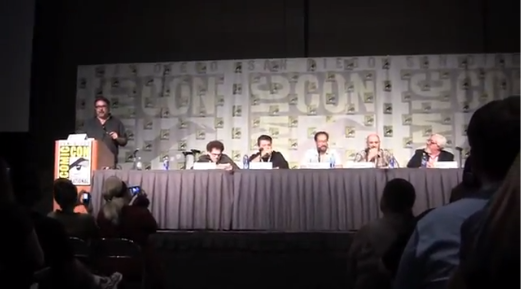
Comic-Con 2013 took place this past weekend in San Diego, and included a panel on the making of Who Framed Roger Rabbit?. The beloved animated movie based on the work of author Gary K. Wolf is celebrating its 25th anniversary this year, and the panel was led by a world class group of animators including producer Don Hahn, animation masters Andreas Deja and James Baxter, writer Tom Sito, special effects guru Dave Bossert, and a special appearance by the voice of Roger Rabbit himself, Charles Fleisher!
There is an audible buzz of excitement throughout the audience for the entirety of the panel, and served to be a great opportunity for fans wanting to discover the ins, outs, trials, tribulations and accomplishments of Who Framed Roger Rabbit?, both during its making and afterwards.
The panel begins by paying homage to Gary K. Wolf, who of course without his novel Who Censored Roger Rabbit?, there would be no script for the movie. The panelists then discuss how Who Framed Roger Rabbit? was one of the first movies to be a hybrid, which combines live action with animated character. At the time (1986), digital technology hadn’t progressed to the point of being even half as fast as it is now, so the movie shines as a “hand painted” work, where every facet of the animation is pure hand creation.
Charles Fleisher, the voice of Roger (as well as Benny The Cab, Greasy, and Psycho), seems very Roger-esque to this day. He hops around on the panel—alternating between sitting, standing, and cracking jokes. He also performs his Roger Rabbit voice after an audience member requests it at the drop of a hat, and it is still flawless, twenty-five years later!
Jessica Rabbit. You knew we were headed there, right? The panelists discuss how Rita Hayworth and various supermodels were inspiration for her. In fact, the animators would have supermodels come into the studio to walk and pose in order to capture an essence of Jessica on paper. Her main animator, Russell Hall, was very quiet and shy according to the panelists, and had a very hard time with her character at first. That is to say, he couldn’t quite bring her to life until he ultimately “exaggerated certain parts of the anatomy” (panelists words!). His routine was to smoke incessantly, get up and move about rather sensually around his office, then get back to his drawing board, never breaking focus. And for this quiet, chain-smoking man who danced solo around his office, we thank you for Jessica Rabbit!
The panel concludes with questions asked by audience members (one woman dressed in impeccable Jessica garb!). The best answer comes from Charles Fleisher, who when asked “How would Roger Rabbit react with current video game characters like Sonic the Hedgehog, Mario, or Optimus Prime?” responds with “He would destroy them all by making them laugh, and then stealing their batteries.”
Well said.
To watch the You Tube video of the Who Framed Roger Rabbit 25th Anniversary at San Diego Comic Con please click HERE.
Remember to be on the lookout for Gary K. Wolf’s new novel in the Roger Rabbit series, Who Wacked Roger Rabbit? available for pre-order by Musa Publishing on October 22nd, and for release on November 22nd! And be sure to check back here for any Roger related news!
There is an audible buzz of excitement throughout the audience for the entirety of the panel, and served to be a great opportunity for fans wanting to discover the ins, outs, trials, tribulations and accomplishments of Who Framed Roger Rabbit?, both during its making and afterwards.
The panel begins by paying homage to Gary K. Wolf, who of course without his novel Who Censored Roger Rabbit?, there would be no script for the movie. The panelists then discuss how Who Framed Roger Rabbit? was one of the first movies to be a hybrid, which combines live action with animated character. At the time (1986), digital technology hadn’t progressed to the point of being even half as fast as it is now, so the movie shines as a “hand painted” work, where every facet of the animation is pure hand creation.
Charles Fleisher, the voice of Roger (as well as Benny The Cab, Greasy, and Psycho), seems very Roger-esque to this day. He hops around on the panel—alternating between sitting, standing, and cracking jokes. He also performs his Roger Rabbit voice after an audience member requests it at the drop of a hat, and it is still flawless, twenty-five years later!
Jessica Rabbit. You knew we were headed there, right? The panelists discuss how Rita Hayworth and various supermodels were inspiration for her. In fact, the animators would have supermodels come into the studio to walk and pose in order to capture an essence of Jessica on paper. Her main animator, Russell Hall, was very quiet and shy according to the panelists, and had a very hard time with her character at first. That is to say, he couldn’t quite bring her to life until he ultimately “exaggerated certain parts of the anatomy” (panelists words!). His routine was to smoke incessantly, get up and move about rather sensually around his office, then get back to his drawing board, never breaking focus. And for this quiet, chain-smoking man who danced solo around his office, we thank you for Jessica Rabbit!
The panel concludes with questions asked by audience members (one woman dressed in impeccable Jessica garb!). The best answer comes from Charles Fleisher, who when asked “How would Roger Rabbit react with current video game characters like Sonic the Hedgehog, Mario, or Optimus Prime?” responds with “He would destroy them all by making them laugh, and then stealing their batteries.”
Well said.
To watch the You Tube video of the Who Framed Roger Rabbit 25th Anniversary at San Diego Comic Con please click HERE.
Remember to be on the lookout for Gary K. Wolf’s new novel in the Roger Rabbit series, Who Wacked Roger Rabbit? available for pre-order by Musa Publishing on October 22nd, and for release on November 22nd! And be sure to check back here for any Roger related news!
Tuesday, July 9, 2013
TIME TRAVEL
Sci-Fi Deak Style
by John Deakins
Fictional Time Travel is so universal that every SF writer feels obliged to write a Time Travel story. “Our heroine’s time machine leaves 2013 Chicago and emerges in . . .” 1913 Chicago, future Chicago, Jurassic Chicago, Native American Chicago; etc. What wonderful possibilities! Unfortunately, Time Travel carries the worst scientific flaws of any major SF idea.
We live in an Einsteinian universe. Newton’s laws also work pretty well. Time Travel requires a Ptolemaic, geocentric universe, of which this ain’t one.
If you travel in Time from a particular spatial location, you should emerge in that same location: Right? As the Earth rotates, Chicago is rolling eastward at 1600 km/hr. In the next second, your position will separate from your original by over 400 meters. Five minutes in Time is over 130 kilometers in space. The spinning Earth just won’t hold still!
Unless you repeal Conservation of Momentum, when you arrive with a twelve clock-hours difference than the time of day you left, you’ll exit onto an Earth in which everything on the rotational counter-side will be slamming into you at 3200 km/hr.
Just make sure that you travel exactly multiples of one day. Chicago will have rotated to the same spot . . . except that the Earth is revolving around the Sun at 30 km/sec more. Five minutes is almost 9000 km away. Even a quick jaunt leaves you breathing vacuum.
Don’t forget the Sun’s orbit around the Milky Way’s core (Add hundreds of km/hr more.) and the motion of the galaxy relative to the space-time continuum. Unless your time machine is also a sealed space craft, you won’t survive to appreciate just how much airless space the universe contains.
What about reentry? When you reach a new space-time locus, will you simply push the air aside as you expand from an infinitesimally small point? That would produce a whopper of a thunderclap. Arriving secretly would be impossible. If your machine were too flimsy, the rebounding shock wave would crush it.
Will you and the local molecules simply become one? Writers agree that arriving inside a solid, regardless of method, would be a poor survival idea. With untold trillions of molecules present, some of yours would arrive inside other molecules. You might blow up like a balloon, or simply blow up. If your atomic nuclei appeared in the same space as local atomic nuclei, and the strong nuclear force would fuse them, with fatal radiation and energy release. Nuclei that were close, but not close enough, would be repelled at particle-collider speeds. You’d create thousands of fast particles that would shred your cells like a radioactive shotgun blast.
We don’t want to give up Time Travel, but what can be done? You can always Ignore It. Your readers are also geocentric. They won’t notice that you can’t travel from now-Chicago to then-Chicago without cheating on the universe’s rules. Have fun.
That’s a solution? We’re Science fiction purists. There has to be a better way. More next time.
John Deakins, B.A., M.S.T. is a four-decade veteran of the science classroom and author of his own fantasy series Barrow.
To read an excerpt from Barrow book one, please click HERE.
by John Deakins
Fictional Time Travel is so universal that every SF writer feels obliged to write a Time Travel story. “Our heroine’s time machine leaves 2013 Chicago and emerges in . . .” 1913 Chicago, future Chicago, Jurassic Chicago, Native American Chicago; etc. What wonderful possibilities! Unfortunately, Time Travel carries the worst scientific flaws of any major SF idea.
We live in an Einsteinian universe. Newton’s laws also work pretty well. Time Travel requires a Ptolemaic, geocentric universe, of which this ain’t one.
If you travel in Time from a particular spatial location, you should emerge in that same location: Right? As the Earth rotates, Chicago is rolling eastward at 1600 km/hr. In the next second, your position will separate from your original by over 400 meters. Five minutes in Time is over 130 kilometers in space. The spinning Earth just won’t hold still!
Unless you repeal Conservation of Momentum, when you arrive with a twelve clock-hours difference than the time of day you left, you’ll exit onto an Earth in which everything on the rotational counter-side will be slamming into you at 3200 km/hr.
Just make sure that you travel exactly multiples of one day. Chicago will have rotated to the same spot . . . except that the Earth is revolving around the Sun at 30 km/sec more. Five minutes is almost 9000 km away. Even a quick jaunt leaves you breathing vacuum.
Don’t forget the Sun’s orbit around the Milky Way’s core (Add hundreds of km/hr more.) and the motion of the galaxy relative to the space-time continuum. Unless your time machine is also a sealed space craft, you won’t survive to appreciate just how much airless space the universe contains.
What about reentry? When you reach a new space-time locus, will you simply push the air aside as you expand from an infinitesimally small point? That would produce a whopper of a thunderclap. Arriving secretly would be impossible. If your machine were too flimsy, the rebounding shock wave would crush it.
Will you and the local molecules simply become one? Writers agree that arriving inside a solid, regardless of method, would be a poor survival idea. With untold trillions of molecules present, some of yours would arrive inside other molecules. You might blow up like a balloon, or simply blow up. If your atomic nuclei appeared in the same space as local atomic nuclei, and the strong nuclear force would fuse them, with fatal radiation and energy release. Nuclei that were close, but not close enough, would be repelled at particle-collider speeds. You’d create thousands of fast particles that would shred your cells like a radioactive shotgun blast.
We don’t want to give up Time Travel, but what can be done? You can always Ignore It. Your readers are also geocentric. They won’t notice that you can’t travel from now-Chicago to then-Chicago without cheating on the universe’s rules. Have fun.
That’s a solution? We’re Science fiction purists. There has to be a better way. More next time.
John Deakins, B.A., M.S.T. is a four-decade veteran of the science classroom and author of his own fantasy series Barrow.
To read an excerpt from Barrow book one, please click HERE.
Tuesday, June 25, 2013
Sure Fire Ways to Procrastinate
by Kendra Leigh Speedling
Writers write every day, they say. It makes sense; the thing that separates writers from People Who Have Ideas is actually writing, and it's easier to keep at it when it's part of a routine. Writing every day not only helps you improve the writing itself, but means that you finish things. It's the advice that comes up in every book, blog, or interview about writing. Write every day.
I would like to extol the virtues of writing every day, but since the most I've done this week is open a Word document before launching myself away from my computer with a wail akin to that of an injured baby manatee,* that would make me a hypocrite.
The usual excuses apply—day job, other obligations, frustration with everything I'm attempting to work on at the moment—but writers work past these things, I've been told. Writers power through scenes even when they feel like they'd get a better result letting the cat walk over the keyboard.
In this particular climate, write every day starts to feel less like advice and more like a rebuke. Where's your discipline? the malicious brain imps will whisper. Don't you know that real writers write every day? The subsequent spiral of guilt and recriminations generally culminates in a realization that I've spent the last three hours alphabetizing my bookshelves so I don't have to acknowledge the fact that I have a manuscript I haven't touched in two weeks.** It eventually evens out again, but I could do without the 3-4 day period where I feel like I'm the laziest person in the entire universe. I used to keep a spreadsheet to enter my word count for each day, but had to stop when each 0 started feeling like a reflection of my worth as a person.
So absolutely, make time for your writing. Try to write every day, or as often as you can. Enjoy those days when it's easy; sit down to write even when it feels your plotline and your life are having a contest to see who can collapse into a gooey mess first. If you really, really can't bear to look at your manuscript on a particular day, write something else: something short, something silly, something about your world, something you don't intend to ever see print. But if you, like me, find yourself sacrificing your sanity for the sake of a word count, don't beat yourself up if a few days pass without anything resembling productivity. You've had a break, and now you can get back to writing.
In the end, it doesn't matter if you write 2000 words a day or 100, write every day, every other, on weekends, in the mornings or evenings or under the light of a full moon. What matters is that you write, and keep writing, and remember why you wanted to write things in the first place.
*I don't actually know if manatees wail, so this may be horridly inaccurate. If you have identified it as such, you clearly know far more about zoology than I do, and can feel free to imagine the animal of your choice.
**The fact that there is an entire website dedicated to the concept of cat vacuuming assures me that I'm not entirely alone in this regard.
Kendra Leigh Speedling's short story "They Shall Know Us At the End" appears in the July issue of Penumbra. She graduated from the University of Minnesota with a major in English and a minor in Asian Languages and Literatures. She is a 2011 Dell Awards finalist, and will someday master the art of productivity.
Writers write every day, they say. It makes sense; the thing that separates writers from People Who Have Ideas is actually writing, and it's easier to keep at it when it's part of a routine. Writing every day not only helps you improve the writing itself, but means that you finish things. It's the advice that comes up in every book, blog, or interview about writing. Write every day.
I would like to extol the virtues of writing every day, but since the most I've done this week is open a Word document before launching myself away from my computer with a wail akin to that of an injured baby manatee,* that would make me a hypocrite.
The usual excuses apply—day job, other obligations, frustration with everything I'm attempting to work on at the moment—but writers work past these things, I've been told. Writers power through scenes even when they feel like they'd get a better result letting the cat walk over the keyboard.
In this particular climate, write every day starts to feel less like advice and more like a rebuke. Where's your discipline? the malicious brain imps will whisper. Don't you know that real writers write every day? The subsequent spiral of guilt and recriminations generally culminates in a realization that I've spent the last three hours alphabetizing my bookshelves so I don't have to acknowledge the fact that I have a manuscript I haven't touched in two weeks.** It eventually evens out again, but I could do without the 3-4 day period where I feel like I'm the laziest person in the entire universe. I used to keep a spreadsheet to enter my word count for each day, but had to stop when each 0 started feeling like a reflection of my worth as a person.
So absolutely, make time for your writing. Try to write every day, or as often as you can. Enjoy those days when it's easy; sit down to write even when it feels your plotline and your life are having a contest to see who can collapse into a gooey mess first. If you really, really can't bear to look at your manuscript on a particular day, write something else: something short, something silly, something about your world, something you don't intend to ever see print. But if you, like me, find yourself sacrificing your sanity for the sake of a word count, don't beat yourself up if a few days pass without anything resembling productivity. You've had a break, and now you can get back to writing.
In the end, it doesn't matter if you write 2000 words a day or 100, write every day, every other, on weekends, in the mornings or evenings or under the light of a full moon. What matters is that you write, and keep writing, and remember why you wanted to write things in the first place.
*I don't actually know if manatees wail, so this may be horridly inaccurate. If you have identified it as such, you clearly know far more about zoology than I do, and can feel free to imagine the animal of your choice.
**The fact that there is an entire website dedicated to the concept of cat vacuuming assures me that I'm not entirely alone in this regard.
Kendra Leigh Speedling's short story "They Shall Know Us At the End" appears in the July issue of Penumbra. She graduated from the University of Minnesota with a major in English and a minor in Asian Languages and Literatures. She is a 2011 Dell Awards finalist, and will someday master the art of productivity.
Thursday, June 20, 2013
Live With It
Sci-Fi Deak Style
by John Deakins
In the case of faster-than-light travel, we’re stuck with Ignore It or Unexplained Science. It’s possible to Live With It. If you can’t go faster than light, go slower than light. We can add Bussard Ram Jets or light sails, gradually accelerating to a useful fraction of light-speed. We won’t even try for trans-light speed, heading outward at a relative crawl. That’ll require decades or centuries of travel. That could work, but those solutions arrive with their own new problems.
We’ll need a “generation” ship even for the close stars. Youthful astronauts launch for Proxima Centauri; their grandchildren arrive to send back data. That involves maintaining a closed ecosystem for decades and shielding passengers and plants from a universe awash with cosmic rays. Otherwise, Generation 1 dies from lack of oxygen or fails to reproduce after being sterilized. Everybody dies of cancer, or the crew can’t control the ship because of accumulated brain damage. Social problems aboard would be huge.
A well-shielded craft would solve some problems, but its mass would reduce it to even slower crawl-speed, no matter what was pushing it. The crew would go from “generation” to generations. Could we maintain a viable social system and a closed ecosystem that long? I doubt it.
A round trip? You’re kidding, right? Slower-than-light flights are all one-way. Earth wouldn’t be your Earth anymore if you ever returned. The big problems rise from keeping a crew awake for an incredibly long time. So, put ‘em to sleep. We don’t have “cold sleep” or suspended animation for humans, but those are the kind of reasonable future developments that Science Fiction thrives on. Don’t wake up the crew, unless you can put them back to sleep. Machines don’t have to worry about century-long flights. Let a super-computer oversee all the sleepers. We could call him “Hal.”
Maybe you could wake the crew periodically. That leads to social complications. What if something goes wrong with the rotation? What if an active crew member goes bonkers?
You’ll need a ship that cosmic rays can’t reach the crew or the frozen passengers. A shaped asteroid would be the logical vessel. You’d have to postulate controlled fusion for energy, a perfectly recycling closed ecosystem, frozen sleep, and solutions to a myriad of social problems, but those are difficult. Trans-light speeds are impossible.
With so many scientific mountains to climb, why would we go there in the first place? Maybe we have to. Has the Earth become uninhabitable? Is the Sun about to explode? Have aliens driven us from our home? The writer can shine with new ideas there. Maybe we just want to go to the stars. Could interstellar travel become a religious quest? Could a star trip become the ultimate “high” for the enormously rich? Perhaps, for certain pre-disposed humans, the stars will become the ultimate Mt. Everest. Each new reason is the parent of another story.
Past writers have found a dozen exits bypassing the “No FTL” roadblock. Try out a few yourself.
John Deakins, B.A., M.S.T. is a four-decade veteran of the science classroom and author of his own fantasy series Barrow.
To read an excerpt from Barrow book one, please click HERE.
by John Deakins
In the case of faster-than-light travel, we’re stuck with Ignore It or Unexplained Science. It’s possible to Live With It. If you can’t go faster than light, go slower than light. We can add Bussard Ram Jets or light sails, gradually accelerating to a useful fraction of light-speed. We won’t even try for trans-light speed, heading outward at a relative crawl. That’ll require decades or centuries of travel. That could work, but those solutions arrive with their own new problems.We’ll need a “generation” ship even for the close stars. Youthful astronauts launch for Proxima Centauri; their grandchildren arrive to send back data. That involves maintaining a closed ecosystem for decades and shielding passengers and plants from a universe awash with cosmic rays. Otherwise, Generation 1 dies from lack of oxygen or fails to reproduce after being sterilized. Everybody dies of cancer, or the crew can’t control the ship because of accumulated brain damage. Social problems aboard would be huge.
A well-shielded craft would solve some problems, but its mass would reduce it to even slower crawl-speed, no matter what was pushing it. The crew would go from “generation” to generations. Could we maintain a viable social system and a closed ecosystem that long? I doubt it.
A round trip? You’re kidding, right? Slower-than-light flights are all one-way. Earth wouldn’t be your Earth anymore if you ever returned. The big problems rise from keeping a crew awake for an incredibly long time. So, put ‘em to sleep. We don’t have “cold sleep” or suspended animation for humans, but those are the kind of reasonable future developments that Science Fiction thrives on. Don’t wake up the crew, unless you can put them back to sleep. Machines don’t have to worry about century-long flights. Let a super-computer oversee all the sleepers. We could call him “Hal.”
Maybe you could wake the crew periodically. That leads to social complications. What if something goes wrong with the rotation? What if an active crew member goes bonkers?
You’ll need a ship that cosmic rays can’t reach the crew or the frozen passengers. A shaped asteroid would be the logical vessel. You’d have to postulate controlled fusion for energy, a perfectly recycling closed ecosystem, frozen sleep, and solutions to a myriad of social problems, but those are difficult. Trans-light speeds are impossible.
With so many scientific mountains to climb, why would we go there in the first place? Maybe we have to. Has the Earth become uninhabitable? Is the Sun about to explode? Have aliens driven us from our home? The writer can shine with new ideas there. Maybe we just want to go to the stars. Could interstellar travel become a religious quest? Could a star trip become the ultimate “high” for the enormously rich? Perhaps, for certain pre-disposed humans, the stars will become the ultimate Mt. Everest. Each new reason is the parent of another story.
Past writers have found a dozen exits bypassing the “No FTL” roadblock. Try out a few yourself.
John Deakins, B.A., M.S.T. is a four-decade veteran of the science classroom and author of his own fantasy series Barrow.
To read an excerpt from Barrow book one, please click HERE.
Tuesday, June 11, 2013
IGNORE IT
Sci-Fi Deak Style
by John Deakins
Nothing goes faster than light; no matter in our universe can reach light-speed. We can’t get around that fact. First, there’s presently no easy way to accelerate to anywhere close to light speed. To leave Earth requires roughly 11,000 m/s. Our fastest spacecraft might have reached 20,000 m/s. The speed of light is 300,000,000 m/s. We’re not even close (.7%). At conventional rocket velocities, the nearest star is over sixty thousand years away. No one is going to survive even the shortest interstellar trip using current technology.
We are Science Fiction! We have to go to the stars! For that, we need trans-light speeds. The first approach we must be Ignore It. An FTL ship takes off from Earth, and after plot-development (days; weeks) reaches Proxima Centauri. Or Hans Solo zooms the Millennium Falcon toward Cloud City. No one asks how his FTL drive works.
Many readers are completely unfamiliar with interstellar distances. They have a feeling that if you go fast enough, you’ll get there in a reasonable time. The trouble is that you can’t go fast enough. The closest star is over four years away at light speed. We don’t produce anything even close to light speed. We’d have trouble keeping interest in a voyage lasting even four years, and no one is projecting any planets orbiting Proxima Centauri. Every reasonable solar system is much farther. A thousand-year star voyage is almost beyond fiction. It rapidly drops off into silly science contrivance. Ignore It burns out its batteries trying to fix too many scientific contradictions. Nevertheless, Ignore It may be the only solution. Hopefully, our plotting will be so good that readership won’t notice when we travel at speeds that simply aren’t possible, never mind the rest of the impossibilities involved.
The second approach is Unexplained Science. No one has to explain how a “warp drive” works on Star Trek; they only have to name it. Some works hint at “wormholes” or “hyper space,” but the smart author will slide around the hard science. If you find a golden egg in your basket, don’t be dumb enough to ask how it arrived. If you postulate a ship with FTL drive, don’t be dumb enough to tinker with explanations. Unfortunately, that makes Unexplained Science just a subset of Ignore It.
How do we make this all work? Ignore It works well in Space Opera. (Have you ever wondered why ships that have anti-gravity and FTL drives still need fuel?) Let’s leave the “how” of FTL and impossible speeds entirely alone and concentrate on the action and the human interplay. Throw in a little Unexplained Science if you think the audience is getting restless.
Limit your FTL Unexplained Science to names only, hopefully a single pseudo-science title: maybe Space-time Folding or Worm-hole generator. Otherwise, you’ll end up looking like the Hollywood pimps are running you, too. (That would make you a . . . Never mind.)
There is another way out, but not this week.
John Deakins, B.A., M.S.T. is a four-decade veteran of the science classroom and author of his own fantasy series Barrow.
To read an excerpt from Barrow book one, please click HERE.
by John Deakins
Nothing goes faster than light; no matter in our universe can reach light-speed. We can’t get around that fact. First, there’s presently no easy way to accelerate to anywhere close to light speed. To leave Earth requires roughly 11,000 m/s. Our fastest spacecraft might have reached 20,000 m/s. The speed of light is 300,000,000 m/s. We’re not even close (.7%). At conventional rocket velocities, the nearest star is over sixty thousand years away. No one is going to survive even the shortest interstellar trip using current technology.
We are Science Fiction! We have to go to the stars! For that, we need trans-light speeds. The first approach we must be Ignore It. An FTL ship takes off from Earth, and after plot-development (days; weeks) reaches Proxima Centauri. Or Hans Solo zooms the Millennium Falcon toward Cloud City. No one asks how his FTL drive works.
Many readers are completely unfamiliar with interstellar distances. They have a feeling that if you go fast enough, you’ll get there in a reasonable time. The trouble is that you can’t go fast enough. The closest star is over four years away at light speed. We don’t produce anything even close to light speed. We’d have trouble keeping interest in a voyage lasting even four years, and no one is projecting any planets orbiting Proxima Centauri. Every reasonable solar system is much farther. A thousand-year star voyage is almost beyond fiction. It rapidly drops off into silly science contrivance. Ignore It burns out its batteries trying to fix too many scientific contradictions. Nevertheless, Ignore It may be the only solution. Hopefully, our plotting will be so good that readership won’t notice when we travel at speeds that simply aren’t possible, never mind the rest of the impossibilities involved.
The second approach is Unexplained Science. No one has to explain how a “warp drive” works on Star Trek; they only have to name it. Some works hint at “wormholes” or “hyper space,” but the smart author will slide around the hard science. If you find a golden egg in your basket, don’t be dumb enough to ask how it arrived. If you postulate a ship with FTL drive, don’t be dumb enough to tinker with explanations. Unfortunately, that makes Unexplained Science just a subset of Ignore It.
How do we make this all work? Ignore It works well in Space Opera. (Have you ever wondered why ships that have anti-gravity and FTL drives still need fuel?) Let’s leave the “how” of FTL and impossible speeds entirely alone and concentrate on the action and the human interplay. Throw in a little Unexplained Science if you think the audience is getting restless.
Limit your FTL Unexplained Science to names only, hopefully a single pseudo-science title: maybe Space-time Folding or Worm-hole generator. Otherwise, you’ll end up looking like the Hollywood pimps are running you, too. (That would make you a . . . Never mind.)
There is another way out, but not this week.
John Deakins, B.A., M.S.T. is a four-decade veteran of the science classroom and author of his own fantasy series Barrow.
To read an excerpt from Barrow book one, please click HERE.
Thursday, May 30, 2013
Write What You Love
by Shannon Fay
The one piece of advice I would give new writers is to not just to write what you know but to write what you love. Maybe you love astronomy and have a head full of constellations, or you have a gift for languages, or you’re an expert in some field or hobby. These things that interest you, that take up your idle time, use these things in your stories. Your knowledge on the subject will give your story more credibility and your passion will give it life.
And the things you love don’t always have to be so specific. Maybe you love unconventional narratives and finding new ways to tell a story. Maybe you love rousing adventures that make the reader forget their troubles here on the ground. Or maybe you think often about how men and women relate to one another, or how parents and children relate to each other, or how people in general relate to each other. Figure out what interests you and cultivate it.
There have been times when I’ve grown stuck while writing, working myself deeper and deeper into a rut the like a wheel spinning in the mud. The most frustrating thing was that there was nothing technically wrong with the stories I was working on: the plotting was sound, the words at the very least in the right order, but there was something missing. I didn’t care. And why didn’t I care? Because I just didn’t care. There was nothing I loved in the story. Usually this happens because I’m so focused on writing something technically good that I stop writing about things I care about. Instead of following my passions I end up following trends, tapping into the popular consciousness rather than my own. And that’s when I get stuck.
There are stories only you can write. They might end up being very weird and/or personal stories, and they’ll probably be rejected a lot. But that just means that when they do connect with someone, the connection is all the stronger.
Write what you love sounds like obvious advice, and it is. In fact, new writers usually have a better handle on it than writers further along the path (in which case maybe this post should be about advice I’d give to ‘old writers’ instead of advice I’d give to new writers, not that I feel overly qualified giving advice to anyone). But it’s something that’s easy to lose sight of. So, even after you’ve written thousands upon ten thousands of words, remember what you love.
Shannon Fay is a freelance writer/assistant bookstore manager living in Halifax, Nova Scotia. She has recently won the James White Award and has had several short stories published in a variety of genres.
Learn more about Shannon Fay on her website.
The one piece of advice I would give new writers is to not just to write what you know but to write what you love. Maybe you love astronomy and have a head full of constellations, or you have a gift for languages, or you’re an expert in some field or hobby. These things that interest you, that take up your idle time, use these things in your stories. Your knowledge on the subject will give your story more credibility and your passion will give it life.And the things you love don’t always have to be so specific. Maybe you love unconventional narratives and finding new ways to tell a story. Maybe you love rousing adventures that make the reader forget their troubles here on the ground. Or maybe you think often about how men and women relate to one another, or how parents and children relate to each other, or how people in general relate to each other. Figure out what interests you and cultivate it.
There have been times when I’ve grown stuck while writing, working myself deeper and deeper into a rut the like a wheel spinning in the mud. The most frustrating thing was that there was nothing technically wrong with the stories I was working on: the plotting was sound, the words at the very least in the right order, but there was something missing. I didn’t care. And why didn’t I care? Because I just didn’t care. There was nothing I loved in the story. Usually this happens because I’m so focused on writing something technically good that I stop writing about things I care about. Instead of following my passions I end up following trends, tapping into the popular consciousness rather than my own. And that’s when I get stuck.
There are stories only you can write. They might end up being very weird and/or personal stories, and they’ll probably be rejected a lot. But that just means that when they do connect with someone, the connection is all the stronger.
Write what you love sounds like obvious advice, and it is. In fact, new writers usually have a better handle on it than writers further along the path (in which case maybe this post should be about advice I’d give to ‘old writers’ instead of advice I’d give to new writers, not that I feel overly qualified giving advice to anyone). But it’s something that’s easy to lose sight of. So, even after you’ve written thousands upon ten thousands of words, remember what you love.
Shannon Fay is a freelance writer/assistant bookstore manager living in Halifax, Nova Scotia. She has recently won the James White Award and has had several short stories published in a variety of genres.
Learn more about Shannon Fay on her website.
Thursday, May 23, 2013
Are You a Science Fiction Writer?
by John Deakins
Never mind what you write: what do you read? Scientists and technologists who never write SF themselves, read it continually. They may not always recognize bad writing, but they’ll immediately spot a scientific or logical blunder. Science fiction has a better educated readership than that of bodice ripper romances. Listen as your SF-reading friends rip into some recently released SF film. Want more readers? Your current readers can make your book by word of mouth, but those readers can kill your book the same way. The Ignore It approach to scientific road-blocks may not be enough.
Live With It
Science is cold, hard, and unyielding, but it won’t let you down on consistency. If you’re stymied by missing FTL drives, write a story with slower-than-light interstellar transport. If it’s too dangerous to land on an alien planet, create a way to make contact without landing. If you can’t use your time machine for time travel, use it for space travel. Real science happens all the time. Most of what happens within our solar system follows fairly simple Newtonian physics, never mind Einstein. That’s a huge canvas on which to paint your word pictures.
You have before you enormous possibilities within Science. Mars doesn’t have multiply armed green Martians, but what it does have is fascinating, even if it is hard, cold, and unyielding.
Unexplained Science.
You don’t have to explain how your SF technology works; you only have to name it. In fact, the more you explain it, the sillier your explanations will sound to anyone who actually knows science. Some stories need controlled time travel, faster-than-light speed, and the ability to smooze with aliens, but the smart author will tiptoe around hard-science details of exactly how those things are accomplished.
The biggest danger of unexplained science lies inside the writer. We know our science. “Unexplained” makes us itch. It’ll be hard not to yield to the pressure to throw in “subspace” devices or “tachyon pulses.” Hollywood pimps are eager for more “drama” in their SF. They know no science, but they’re full of hackneyed “science fiction” ideas. (Well . . . they’re full of something.) Their “science” explanations stink up the genre; flawed logic flows from mainstream media as from a ruptured sewer line. How easily unexplained science crosses over into partially explained fantasy! On the west coast, that’s a mighty thin line. Nevertheless, it’s a line that we shouldn’t cross.
It’s time now to take on the behemoths of science fiction. We’ll beat them into submission, and then harness them to pull our stories. The blogs that follow are full of story “hooks.” If one snags you, go with it If you get that literary gestalt, when a story leaps full-blown into your mind, quit reading this and write that story. When you do, you’ve made this work a success.
John Deakins, B.A., M.S.T. is a four-decade veteran of the science classroom and author of his own fantasy series Barrow.
To read an excerpt from Barrow book one, please click HERE.
Never mind what you write: what do you read? Scientists and technologists who never write SF themselves, read it continually. They may not always recognize bad writing, but they’ll immediately spot a scientific or logical blunder. Science fiction has a better educated readership than that of bodice ripper romances. Listen as your SF-reading friends rip into some recently released SF film. Want more readers? Your current readers can make your book by word of mouth, but those readers can kill your book the same way. The Ignore It approach to scientific road-blocks may not be enough. Live With It
Science is cold, hard, and unyielding, but it won’t let you down on consistency. If you’re stymied by missing FTL drives, write a story with slower-than-light interstellar transport. If it’s too dangerous to land on an alien planet, create a way to make contact without landing. If you can’t use your time machine for time travel, use it for space travel. Real science happens all the time. Most of what happens within our solar system follows fairly simple Newtonian physics, never mind Einstein. That’s a huge canvas on which to paint your word pictures.
You have before you enormous possibilities within Science. Mars doesn’t have multiply armed green Martians, but what it does have is fascinating, even if it is hard, cold, and unyielding.
Unexplained Science.
You don’t have to explain how your SF technology works; you only have to name it. In fact, the more you explain it, the sillier your explanations will sound to anyone who actually knows science. Some stories need controlled time travel, faster-than-light speed, and the ability to smooze with aliens, but the smart author will tiptoe around hard-science details of exactly how those things are accomplished.
The biggest danger of unexplained science lies inside the writer. We know our science. “Unexplained” makes us itch. It’ll be hard not to yield to the pressure to throw in “subspace” devices or “tachyon pulses.” Hollywood pimps are eager for more “drama” in their SF. They know no science, but they’re full of hackneyed “science fiction” ideas. (Well . . . they’re full of something.) Their “science” explanations stink up the genre; flawed logic flows from mainstream media as from a ruptured sewer line. How easily unexplained science crosses over into partially explained fantasy! On the west coast, that’s a mighty thin line. Nevertheless, it’s a line that we shouldn’t cross.
It’s time now to take on the behemoths of science fiction. We’ll beat them into submission, and then harness them to pull our stories. The blogs that follow are full of story “hooks.” If one snags you, go with it If you get that literary gestalt, when a story leaps full-blown into your mind, quit reading this and write that story. When you do, you’ve made this work a success.
John Deakins, B.A., M.S.T. is a four-decade veteran of the science classroom and author of his own fantasy series Barrow.
To read an excerpt from Barrow book one, please click HERE.
Tuesday, May 21, 2013
On Writing Advice
by Michael Hodges
Writing advice all tends to blend into wallpaper. And soon it becomes like that old peeling stuff in your kitchen you pretend isn’t there as you glance back down at your coffee cup. I could write about using too many “ly” adverbs, or not to use “and” too often in one sentence (Mr. McCarthy would disagree), or even suggest copies of On Writing or The Elements of Style. I could say “find your voice”…something I think is more about writing a lot and consuming stimulants than performing Jedi mind tricks. These are all fine things. But you probably know them.
Discussing one aspect of writing will almost certainly segue to others. There’s an ecosystem here, an unavoidable connection. We void these connections at our own peril.
In our daily paths, we try to make that separation. We are closer to the plump raccoon that sneaks onto our porch at night than we like to think. There are things out there—living, breathing things that share our space in this world. The raccoons, the bats, the geese, the frogs, this frenetic symphony amongst the soggy parks and brown rivers that we pass on our way to Costco or whatever the next big box store is. If we are holding coffee, perhaps we can avert our gaze once more.
We are slaves to the sun. We are forced to wake and sleep, wake and sleep in the rhythms that have brushed this planet for billions of years. But today, and maybe just today, you are free. The world is more than credit and bills and our paths amongst the strip malls.
What is real? What is important?
Writing is one of them. You know this or you wouldn’t be here. And I guess this leads me to pluck a single focal point for this piece:
Awareness.
It’s the writer’s best friend. Wayne Coyne of the Flaming Lips, in their classic song “Do You Realize” asked, Do you realize, we’re floating in space?
No shit. We’re floating in space. Once you are aware of this truism, you are already ahead of the game. The writer, at his or her desk is at that moment, floating in space. Your mind is the sun, your hands the rain, your writing software the caked plains of Northern Africa.
What is important? What moves you? Can you feel all of this about you? The violence and the love and the dying and birthing? There are few things we have control over. Writing is one of them.
So go. Create your own universes within universes. Today, you are the creator, and the characters in your stories will wake and rest to the sun of your mind.
Michael Hodges resides in Chicagoland, but often dreams of the Northern Rockies. His work has appeared in numerous magazines and anthologies. He is represented by FinePrint literary, and hard at work on a new novel. You can find out more on his website.
Writing advice all tends to blend into wallpaper. And soon it becomes like that old peeling stuff in your kitchen you pretend isn’t there as you glance back down at your coffee cup. I could write about using too many “ly” adverbs, or not to use “and” too often in one sentence (Mr. McCarthy would disagree), or even suggest copies of On Writing or The Elements of Style. I could say “find your voice”…something I think is more about writing a lot and consuming stimulants than performing Jedi mind tricks. These are all fine things. But you probably know them.Discussing one aspect of writing will almost certainly segue to others. There’s an ecosystem here, an unavoidable connection. We void these connections at our own peril.
In our daily paths, we try to make that separation. We are closer to the plump raccoon that sneaks onto our porch at night than we like to think. There are things out there—living, breathing things that share our space in this world. The raccoons, the bats, the geese, the frogs, this frenetic symphony amongst the soggy parks and brown rivers that we pass on our way to Costco or whatever the next big box store is. If we are holding coffee, perhaps we can avert our gaze once more.
We are slaves to the sun. We are forced to wake and sleep, wake and sleep in the rhythms that have brushed this planet for billions of years. But today, and maybe just today, you are free. The world is more than credit and bills and our paths amongst the strip malls.
What is real? What is important?
Writing is one of them. You know this or you wouldn’t be here. And I guess this leads me to pluck a single focal point for this piece:
Awareness.
It’s the writer’s best friend. Wayne Coyne of the Flaming Lips, in their classic song “Do You Realize” asked, Do you realize, we’re floating in space?
No shit. We’re floating in space. Once you are aware of this truism, you are already ahead of the game. The writer, at his or her desk is at that moment, floating in space. Your mind is the sun, your hands the rain, your writing software the caked plains of Northern Africa.
What is important? What moves you? Can you feel all of this about you? The violence and the love and the dying and birthing? There are few things we have control over. Writing is one of them.
So go. Create your own universes within universes. Today, you are the creator, and the characters in your stories will wake and rest to the sun of your mind.
Michael Hodges resides in Chicagoland, but often dreams of the Northern Rockies. His work has appeared in numerous magazines and anthologies. He is represented by FinePrint literary, and hard at work on a new novel. You can find out more on his website.
Thursday, May 16, 2013
Is Truth Stranger than Fiction?
by Elizabeth Porter Birdsall
It's been said often enough to become cliché: truth is stranger than fiction. But when we write about aliens and magic and strange creatures from beyond the abyss, it's sometimes easy to doubt that. Of course, fiction has to follow an internal story-logic in a way real life doesn't, but surely the real world – this boring, everyday world where we go to school and pay our bills and trudge along the same streets day in and day out – doesn't have a patch on what we can come up with in our flights of imagination.
The human imagination is a wonderful, expansive, glorious thing. I mean no insult to it at all when I say that I respectfully disagree with the notion that we can come up with things stranger than the universe already has. What is imagination, after all, but another way to look at the world around us? A way to reshape the world, to draw one thing out of focus so we can get a different, better view on something else? And that world is full of bizarre marvels.
When I'm looking for ideas for a story, one of the first things I do is look to nature. It's probably obvious that I did that for my story "Convergent Motion," which takes place among sea slugs at the bottom of the sea. (And all the weirdest bits, except the starting conceit of bodiless spirits, come straight from fact.) But a story doesn't have to be set among hydrothermal vents to draw on the strangeness of the world. Speculative fiction explores the corners of the universe, and the what-ifs that might live there. That can mean the edges of the galaxy, or your own backyard; it can mean the crushing depths of the sea, or the overlooked cracks in the sidewalk. Writers and artists are among the people who stop, and look closer, and look again. We study, and we dream, and then we transform what we've studied into what we've dreamed about.
Of course, that doesn't mean that the job of speculative fiction (or any fiction) is simply to talk about the strange bits of the world exactly as they are. That wouldn't be much speculation, for one thing, but more importantly it wouldn't be much fiction. One of the important jobs of fiction, in my opinion, is to take something outside the reader – whether it's the bottom of the sea or the thoughts in their next-door neighbor's head – and make that something seem close and comprehensible and important. Speculative fiction tries to look to farther shores and wider vistas, but the principle is the same.
Truth is stranger than fiction? All right, sure. But that's the beauty of it. Because fiction arises from truth, and opens a window onto it; that's the whole point of speculation.
It's been said often enough to become cliché: truth is stranger than fiction. But when we write about aliens and magic and strange creatures from beyond the abyss, it's sometimes easy to doubt that. Of course, fiction has to follow an internal story-logic in a way real life doesn't, but surely the real world – this boring, everyday world where we go to school and pay our bills and trudge along the same streets day in and day out – doesn't have a patch on what we can come up with in our flights of imagination.The human imagination is a wonderful, expansive, glorious thing. I mean no insult to it at all when I say that I respectfully disagree with the notion that we can come up with things stranger than the universe already has. What is imagination, after all, but another way to look at the world around us? A way to reshape the world, to draw one thing out of focus so we can get a different, better view on something else? And that world is full of bizarre marvels.
When I'm looking for ideas for a story, one of the first things I do is look to nature. It's probably obvious that I did that for my story "Convergent Motion," which takes place among sea slugs at the bottom of the sea. (And all the weirdest bits, except the starting conceit of bodiless spirits, come straight from fact.) But a story doesn't have to be set among hydrothermal vents to draw on the strangeness of the world. Speculative fiction explores the corners of the universe, and the what-ifs that might live there. That can mean the edges of the galaxy, or your own backyard; it can mean the crushing depths of the sea, or the overlooked cracks in the sidewalk. Writers and artists are among the people who stop, and look closer, and look again. We study, and we dream, and then we transform what we've studied into what we've dreamed about.
Of course, that doesn't mean that the job of speculative fiction (or any fiction) is simply to talk about the strange bits of the world exactly as they are. That wouldn't be much speculation, for one thing, but more importantly it wouldn't be much fiction. One of the important jobs of fiction, in my opinion, is to take something outside the reader – whether it's the bottom of the sea or the thoughts in their next-door neighbor's head – and make that something seem close and comprehensible and important. Speculative fiction tries to look to farther shores and wider vistas, but the principle is the same.
Truth is stranger than fiction? All right, sure. But that's the beauty of it. Because fiction arises from truth, and opens a window onto it; that's the whole point of speculation.
Subscribe to:
Posts (Atom)


