Wish You and Yours
Showing posts with label Penumbra EMag. Show all posts
Thursday, November 28, 2013
Tuesday, November 19, 2013
New Lands and New Possibilities
by Chris Pavesic
Speculative fiction is not a new invention. It has existed at least since Beowulf (probably earlier, but without print or other recorded versions we cannot say for sure). Indeed, speculative stories cover the globe and are found in all cultures and in all epochs. In these tales humans place their sense of wonder about the world and its creatures, life, death, love, hate, and the other mysteries. Authors use speculative stories to try and help them understand the world around them and bring readers along for the imaginative journey. The territory just beyond the borders of their experience becomes their artistic playgrounds where anything (and everything) is possible.
There was never an era in recorded human history when people did not wonder what might lie beyond the next hill (or beyond the next star-system); those storytellers—and then authors—filled the blank spaces on their maps with their imagination. The authors of speculative fiction—writers like Homer, Malory, Tennyson, Shakespeare, Stoker, Poe, Wells, King, and Rowling—and the stories they and others created—Beowulf, The Adventures of Huckleberry Finn, The Mists of Avalon, The River of Dancing Gods, The Hitchhiker’s Guide to the Galaxy, and The Hunger Games —are part of our literary and cultural touchstones. These authors worked at filling in (and then expanding) the map with the worlds they envisioned— Discworld, OZ, Gormenghast, Wonderland, Xanth, and Pern to name just a few.
In uncharted places, some cartographers would write the warning “Here There Be Monsters” on maps. Writers of speculative fiction were never content with this, however. Questions about the types of monsters, their purpose, the reasons for their creation, and their motivations needed to be answered, and indeed answered in the most entertaining way possible. The men and women who battled against them needed to be described and honored in print for their achievements and explorations, even if the battles were only in our imaginations. Conan, Drizzt, Haroun, Coraline, Stark, and Dresden—Joseph Campbell described these types of literary creations as “the hero with a thousand faces” because these archetypes appeared again and again, always ready to start down the path and begin the hero’s journey in these new, uncharted lands. And because they were interesting—because we wanted to see how they fared against both the figurative and literal monsters—we readers would follow these heroes into the speculative landscapes. What we learned on these journeys about our own lives, world, values, beliefs, and so forth was just as illuminating as what the heroes learned about their fictional world(s).
Being a reader (as well as a writer) of speculative fiction, I realize that I can picture many of these landscapes more clearly than I do many of the places of the “real” world. Without much effort I can pull memories of pushing through pine trees covered in clumps of snow like Lucy just before she reaches the lamp post in Narnia, I can remember the terrifying, oppressive darkness and ruined grandeur of the dwarf mines in Middle Earth (and also the quiet English-like flower and vegetable garden settings of the Shire complete with the round doors of the hobbit holes), and I can recall the thrill of standing on the deck of the Neverland pirate ship, complete with the smell of the sea and the splash of the salt water on my face. (And because I am an avid reader of these stories, I need to stop this list before it grows intolerably long!) These settings unfolded the marvels and perils of all that I had always suspected was just past my immediate horizon—indeed just over the next hill; I just had to muster the courage to start my own hero’s journey and find them for myself.
By publishing speculative fiction, Penumbra has joined this vast literary tradition. With each issue the authors add new dimensions and nuances to the unexplored places on the map. New worlds are envisioned by authors and new landscapes are explored by readers who are yearning to push past the borders of their experience to see places that are out of reach only for those who lack the imagination to make the voyage. In the pages of the magazine readers may discover (in highly personal ways) other arrangements and interpretations of experience that directly relate to their daily lives. In those new imaginary places on the map, we may indeed find a sense of wonder—complete with monsters and high adventure—and we also may broaden our knowledge of our own world and find new inspiration to continue on our own hero’s path. Anything (and everything) is possible.
Chris Pavesic lives in the Midwestern United States and loves Kona coffee, fairy tales, and all types of speculative fiction. Her stories, “Going Home” and “The World In Front of Me,” have been published in Penumbra EMag. Between writing projects, Chris can most often be found reading, gaming, gardening, working on an endless list of DIY household projects, or hanging out with friends.
Stay in touch with Chris on her blog.
Tuesday, November 12, 2013
Penumbra of the Orange Donkey
by B. Morris Allen
I started writing when I was young. It’s probably for the best that there’s only one survivor of the period, a piece called “The Orange Donkey”. It reads like what it is, a story written by a six year old. My parents were proud, but despite their acclaim, I didn’t do much more writing until a few desultory pieces for a college writing class.
After college, as I was deciding what to do about not becoming a veterinarian, I tried my hand at writing. I produced the outline and opening chapters of a fantasy novel, and a short story based on a Deep Purple song, “Blind”. Then graduate school called, and I gave up on writing again.
Over the next two decades, I sent out “Blind” every couple of years, with no result – mostly with no answer at all. Meanwhile, my writing process consisted of: 1) waiting for inspiration to strike, and 2) hoping to be near a keyboard or pen when that happened. It’s surprising how rarely the two coincide. My total output was essentially nil, though I did keep my ‘idea’ file regularly topped up.
In the fall of 2010, something changed – Absent Willow Review (now sadly defunct), accepted “Blind”, the story I’d been sending around for so long. When the shock wore off, I sat down to think. Clearly, my inspiration-based process wasn’t working; twenty years is a pretty fair test period. At the same time, I was working as a short-term consultant; I had time free between gigs. I’m pretty serious about my work. Why not do what so many people recommend, and treat writing as a job?
As with an annoyingly high percentage of popular wisdom, it worked. Every day, after an hour futzing around doing nothing, I would find my rhythm, and the words would pour out. At one point, I was writing a story a day – good ones! I found myself racing to complete stories before the mailman arrived, so that I could send them to those irritating magazines that only accept hardcopies. I was about to burst onto the writing scene in a big way!
Or maybe in a small way. My scintillating prose didn’t seem to wow the editors (it may be that the whole type-and-send approach deserved a rethink). Equally important, I accepted a full-time job, and my period of high production came to a close after only two months.
I kept writing new stories, but at a much slower rate – perhaps one a quarter, if I was lucky. One such was “Tocsin”, inspired by Thomas Covenant; at least, I was reading the latest by Stephen Donaldson, and he used the word. My immediate reaction was “Hey! [Fellow writer] Fran Wilde could use that” as the title for a story of hers that I loved, and which involved ships, a bell, and mysterious disappearances. Unfortunately, her story was more hopeful and uplifting, and I decided the title didn’t fit after all. So I was left with a clever title but no story to go with it. “Tocsin”, with its steady rhythm and echoes of John Donne, is what I came up with.
Despite my meager output, I’d been selling stories occasionally to ‘semi-pro’ venues during 2011 and 2012, and I’d reconciled to the idea of taking the world by light breeze, instead of by storm. Then, in February this year, Penumbra accepted “Tocsin” for its Ocean-themed issue. My first ‘professional’ sale!
Real world requirements have prevented much new writing this year, so the Penumbra sale didn’t open the floodgates, but there are several stories due in anthologies in the near future (including “Blind”, I’m happy to say). I’ve also been experimenting with self-publishing – a few stories, two collections, a novella.
It’s been a long, leisurely path from Alfred the Orange Donkey to here, but I like to think that he’d be pleased with the result. Despite the slowdown in production at the story factory, there’s a sizeable batch of new stories awaiting finishing touches, so there’s a chance that light breeze will pick up soon. Keep your eyes open for a change in the weather!
B. Morris Allen grew up in a house full of books that traveled the world, and was initially a fan of Gogol and Dickens. Then, one cool night, he saw the light of Barsoom...
B. Morris has been a biochemist, an activist, and a lawyer. He pauses from time to time on the Oregon coast to recharge, but now he's back on the move, and the books are multiplying like mad. When he can, he works on his own contributions to speculative fiction.
Thursday, November 7, 2013
AGENCY
by Beth Cato
"Agency" is one of those terms that gets bandied about by writers and editors. But what IS agency?
This is something I've been delving into recently as I've been working on novel edits. I thought I understood agency. I have a main character with profound magical powers. If a building is on fire, she's the one who will dash inside to save people. She will go hungry if her coins will buy food for a beggar child. She's brave and resourceful when needed, and known to sling about a witty comment or two.
I had the big aspects of agency down, but what I forgot were the everyday details. Yes, my protagonist may be the one to dash into the burning building--but was it her suggestion to go to that street in the first place, or did a minor character coax her that way?
Minor characters are called minor for a reason. When I scrutinized my text word by word, I found that all too many times, the minor characters were the ones making the choice in those little directional shifts in the plot. Being the amiable sort, my protagonist nodded and went along.
Note: Agency shouldn't be confused with making a protagonist brash or bitchy, though some stories (urban fantasy in particular) do this well (or not well, depending on how you like the genre). It's about having the protagonist speak up first, even if it's in a whisper. They need to be the one to say, 'No. Let's go this way.'
Your character can be a god incarnate, but if someone is always telling them where to go, how much power do they really possess?
Beth Cato was the featured author in the Penumbra EMag May 2013 ocean-themed issue with her story "Clementine, Who Swims with Mermaids." In conjunction with Musa Publishing's birthday celebration this issue, and several others, can be purchased here at a 30% discount. Her poems also appeared in our Zombie and Space Opera volumes.
Her debut steampunk novel will be published by HarperCollins Voyager in late 2014.
Learn more about Beth’s stories, poems, and tasty cookie recipes on her website.
"Agency" is one of those terms that gets bandied about by writers and editors. But what IS agency?This is something I've been delving into recently as I've been working on novel edits. I thought I understood agency. I have a main character with profound magical powers. If a building is on fire, she's the one who will dash inside to save people. She will go hungry if her coins will buy food for a beggar child. She's brave and resourceful when needed, and known to sling about a witty comment or two.
I had the big aspects of agency down, but what I forgot were the everyday details. Yes, my protagonist may be the one to dash into the burning building--but was it her suggestion to go to that street in the first place, or did a minor character coax her that way?
Minor characters are called minor for a reason. When I scrutinized my text word by word, I found that all too many times, the minor characters were the ones making the choice in those little directional shifts in the plot. Being the amiable sort, my protagonist nodded and went along.
Note: Agency shouldn't be confused with making a protagonist brash or bitchy, though some stories (urban fantasy in particular) do this well (or not well, depending on how you like the genre). It's about having the protagonist speak up first, even if it's in a whisper. They need to be the one to say, 'No. Let's go this way.'
Your character can be a god incarnate, but if someone is always telling them where to go, how much power do they really possess?
Beth Cato was the featured author in the Penumbra EMag May 2013 ocean-themed issue with her story "Clementine, Who Swims with Mermaids." In conjunction with Musa Publishing's birthday celebration this issue, and several others, can be purchased here at a 30% discount. Her poems also appeared in our Zombie and Space Opera volumes.
Her debut steampunk novel will be published by HarperCollins Voyager in late 2014.
Learn more about Beth’s stories, poems, and tasty cookie recipes on her website.
Tuesday, November 5, 2013
Two Years of Penumbra
by Dianna L. Gunn
Two years ago I sent an email to a woman named Celina asking if I could intern with her brand new publishing company. To be honest, as a writer with only a couple non-fiction clips and still in high school, I didn't expect to hear back. I was happily surprised when she invited me to become an intern, and happier still when I was moved from Musa Publishing to Penumbra EMag. Soon enough I was put in charge of this blog, and through it I've had the opportunity to work with many great authors.
Over the two years since my internship began, many things have changed. Musa has grown exponentially, publishing the works of Gary K. Wolf and the late great Homer Eon Flint. The website has been made over and we've published hundreds of books. This little publisher has grown to be a massive force that attracts some of speculative fiction's most renowned authors away from the Big Six. We have proven that an ebook publisher, who's completely open and honest with its authors, can succeed and that we can publish several good books in a single month.
I have also changed. I graduated high school, but I'm staying for an extra semester to help launch some massive writing projects. I have fallen in and out of love. I have become a woman in the eyes of the law, and I am now preparing to move out on my own for the first time. I've experimented with freelance writing and decided I'd rather have a normal job for now. I've written and edited several books of my own, and I am slowly gearing up to start submitting my first novel.
The literary world has changed, too. Ebooks are on the rise. J.K. Rowling is writing something other than Harry Potter. One of the most brilliant minds of the last century, Ray Bradbury, has been lost to the world.
As the third year of Penumbra begins it is time to celebrate what we've accomplished so far and the great successes soon to come. As such, we'll have different authors from this past year make an appearance here to talk about speculative fiction and Penumbra EMag. I hope you'll enjoy reading these posts as much as I've enjoyed working with these authors.
Dianna L. Gunn is a young Canadian fiction writer who specializes in dark fantasy. She also writes poetry, generally dark, which is her way of dealing with life. This insightful author hosts a website covering every aspect of fiction writing and interviews with noted guest authors.
Learn more about Dianna L. Gunn on her website and follow her on Twitter.
Thursday, October 31, 2013
Long Live Penumbra EMag!
by Brian Griggs
Anniversaries are a big deal. I don’t think that I need to remind anyone of the elaborate parties that werewolves host every full moon (they’re rip-roaring events, to be sure) and everyone knows that the exploding giants of Erb’durindian can bring the house down. Don’t get me started on how husbands on Shazbar 3 have no excuse for forgetting anniversaries even though the planet completes an orbit every 55 days. You and I know that, whether you’re a squidfolk, an automaton, or somewhere in-between, anniversaries are a big deal.
It should come as no surprise, then, that Penumbra’s anniversary is an event to watch. Rumor has it that Paulis is grilling up some sim-steak and galta-fish for the potluck. Kyr is bringing his patented pre-fab coffee, which I hear is to die for. And for the first time in a long time, Wendell, Custodian of the Galaxy, will not have to clean up the whole thing afterwards.
It’s a time to celebrate, a time to enjoy hanging out with characters from all branches of speculative fiction. Because where else can you find great homages to Ray Bradbury one month and then the next be immersed in the zombie apocalypse? If you’re a fan of the imagination, Penumbra is your place.
I’ve enjoyed having stories run in issues of Penumbra EMag and it’s not just because I love seeing my name on their beautiful covers (thank you, Celina Summers and Kelly Shorten!). I know that when I have a story in an issue of Penumbra, I know that I’m a part of something bigger than myself. Fans of speculative fiction who are fans just like me will read our stories. I know that it’s about the quality of the story, the believability of the unbelievable, and not limited to what some big corporation says is good. (This is where I ask people to purchase a year’s subscription, right?)
I love that Musa Publishing is keeping great short stories and poems in the hands/ereaders/tentacles of spec fic fans because it is an art form that I don’t want to see disappear. There’s a powerful lineage with spec fic short works. Imagine a world without the kid genius going to Battle School or without the mind-altered man and his mouse, Algernon. The world would be drastically different, like “stepping on a butterfly while hunting a Tyrannosaur” different. Penumbra is doing its part to find this generation’s up-and-coming greats.
So here’s to Penumbra EMag! Happy anniversary! May your issues keep coming and may your trade routes be free of deathbots.
Brian Griggs is the World's Tallest (Non-Guinness Endorsed) Librarian and has been an educator for 12 years. He knows that there's hope for the next generation when a student raves about how crazy the ending to Ender's Game is or when he hears a student shout, "Long live the fighters!"
Find more updates from Brian on his website or if you have a recent deathbot sighting, you can message him on Twitter.
Tuesday, October 29, 2013
ONLY 2 DAYS LEFT
to celebrate
Musa Publishing's
second birthday
with
great deals on top selling books!
with
great deals on top selling books!
BIRTHDAY BONUS
Free copy of
Cooking with Musa
with every book purchased
Click Musa Publishing for exciting books.
Enjoy our Blog with fun topics and fantastic recipes.
Speculative fiction fans be sure to read Penumbra eMag Blog.
And of course, check us out on Facebook.
Thursday, October 24, 2013
An Anxiety of Influence
by Steve Chapman
My story The Driver was written “in the style of” Ray Bradbury and published in Penumbra’s Bradbury tribute issue. In the wake of that story (of which I’m quite fond), a number of “in the style of” projects caught my eye, anthologies of new stories written in tribute to Jack Vance, Gene Wolfe, and Roger Zelazny, to name the first three that come to mind.
My first impulse was discomfort. Was all this tributing a bad idea? Shouldn’t writers be developing their own distinct voices, rather than trying to ape their forebears?
There have always been tribute books and stories in the relatively small neighborhood of speculative fiction. Motivations of genuine celebration and pragmatic brand extension drive such enterprises, often a bit of both. For an author, trying on a different, distinctive voice can be fun and instructive. That had been my experience on the Bradbury story. But what does the reader get out of it?
It struck me that there’s a voluminous SFF tradition of stories written “in the style of” H.P. Lovecraft going back twenty years at least, that once upon a time I was pretty familiar with. When I was younger, having run out of actual Lovecraft, I would hunt down these secondhand stories hoping to extract some fraction of the pleasure I got from the real thing.
That didn’t happen often, but over time I was struck by the fact that my enjoyment of such stories often came from writers bringing distinct voices to bear on the original material. Fred Chappell and Ramsey Campbell jump to mind as authors who applied their own style and concerns to Lovecraftian tropes, creating striking stories and novels. In a different mode, but equally pleasurable, are Neil Gaiman’s Lovecraft pastiches – deconstructive and humorous more often than not.
So there are clearly modes of writing ‘in tribute’ that result in quality work.
I wonder if I suffered little of this anxiety of influence in writing the Penumbra tribute because Bradbury has always seemed to me ground zero for story construction. A Bradburyesque story requires a clear, simple SFF concept, evocative but straightforward prose, and a fable-like insistence on teasing out the emotional meaning of the concept. This has always seemed to me like an essential thing to know how to do – not as well as Bradbury, of course, but necessary in the manner of basic draftsmanship to a painter.
What I learned from that story is that writing ‘in the style of’ Bradbury meant a striking concept, unfussy writing, and a clear emotional through line, requirements not so different from simply “write a good story.” For someone else, another writer might fill this position. Perhaps to an author there is real value in imitating/interrogating the styles of the authors who feel most essential to you.
A lapsed musician and engineer, Steve Chapman lives with his wife and daughter at the New Jersey shore. Though he spends most days high above Times Square, in the evenings he can hear the ocean. Recent stories can be round in Marion Zimmer Bradley’s Sword & Sorceress 27, the Harrow Press anthology Mortis Operandi, and the January 2013 issue of Penumbra.
Tuesday, October 22, 2013
HAPPY BIRTHDAY!
by Edoardo Albert
In honour of Penumbra’s second birthday, and without the slightest (well, hardly) intention to ingratiate myself with its editors, may I say that this is undoubtedly the friendliest and most professional magazine I’ve dealt with. Penumbra pays well, looks marvellous, responds quickly and, apart from publishing my stories, provides me with this free soapbox to advertise myself and my wares. What’s not to like? And, more importantly, long may it continue, particularly if it publishes more of my stories.
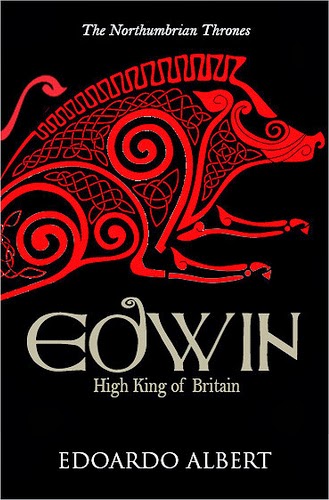
Dianna Gunn, intern par excellence, asked me to write something about what I’ve been up to since appearing in the magazine (since you ask, the Revolution and Exploration issues) and it just so happens that I have my first novel due out next March.
It’s only taken me thirty-two years to get to this stage! Anyway, Edwin: High King of Britain was a result of the research that went into writing my book, Northumbria: the Lost Kingdom, on the history and archaeology of one of the key Dark Ages kingdoms of England (although, of course, England didn’t actually exist then). The story of the three successive Northumbrian kings whom the Venerable Bede accords the title bretwalda – that is High King of Britain – seemed so extraordinary I was astonished that nobody had written about them before. So I decided to.
One of the advantages of doing things this way round was that I had already done most of the historical research necessary – it was just a matter of trying to bring it all to life. Hopefully I have done so, it would be a grave discourtesy to some extraordinary but all but forgotten people if I haven’t. The book will be published by Lion Fiction in March. The publishers, spotting a link, have given the trilogy the overarching title of The Northumbrian Thrones but in truth, there really was something very like a game for thrones going on in the bloody, violent but extraordinarily creative kingdoms of seventh-century Britain. The foundations of England were laid, amid historical darkness, in a time when the only certainty for a king was a violent death. And yet, perhaps because of the very precariousness of the times, these men and women created things, such as the Lindisfarne Gospels and the Sutton Hoo jewellery, of quite extraordinary beauty. While in some ways the kings of the Early Medieval Period (the preferred academic term today) were like Mafia dons, enforcing protection rackets on their subjects, yet the culture they created and their sensitivity to language were as far removed from the profane and profanity filled life of a John Gotti as it is possible to be.
To do such times and such people justice is no small task. I can hardly hope to have succeeded, but at least I hope not to have failed.
Edoardo Albert is, on paper at least, a surprisingly exotic creature: Italian, Sinhala and Tamil by background, he grew up in London among the polyglot children of immigrants (it was only when he went to university that he actually got to know any English people). He avers that he once reduced a reader to helpless, hysterical laughter. Unfortunately, the piece that did so was a lonely-hearts ad.
Find Edoardo Albert’s books (he’s particularly proud of Northumbria: The Lost Kingdom) and stories via his website although the lonely-hearts ad will not be making an appearance in the foreseeable future. Connect with him through his blog, Twitter or Facebook.
In honour of Penumbra’s second birthday, and without the slightest (well, hardly) intention to ingratiate myself with its editors, may I say that this is undoubtedly the friendliest and most professional magazine I’ve dealt with. Penumbra pays well, looks marvellous, responds quickly and, apart from publishing my stories, provides me with this free soapbox to advertise myself and my wares. What’s not to like? And, more importantly, long may it continue, particularly if it publishes more of my stories.
Dianna Gunn, intern par excellence, asked me to write something about what I’ve been up to since appearing in the magazine (since you ask, the Revolution and Exploration issues) and it just so happens that I have my first novel due out next March.
It’s only taken me thirty-two years to get to this stage! Anyway, Edwin: High King of Britain was a result of the research that went into writing my book, Northumbria: the Lost Kingdom, on the history and archaeology of one of the key Dark Ages kingdoms of England (although, of course, England didn’t actually exist then). The story of the three successive Northumbrian kings whom the Venerable Bede accords the title bretwalda – that is High King of Britain – seemed so extraordinary I was astonished that nobody had written about them before. So I decided to. One of the advantages of doing things this way round was that I had already done most of the historical research necessary – it was just a matter of trying to bring it all to life. Hopefully I have done so, it would be a grave discourtesy to some extraordinary but all but forgotten people if I haven’t. The book will be published by Lion Fiction in March. The publishers, spotting a link, have given the trilogy the overarching title of The Northumbrian Thrones but in truth, there really was something very like a game for thrones going on in the bloody, violent but extraordinarily creative kingdoms of seventh-century Britain. The foundations of England were laid, amid historical darkness, in a time when the only certainty for a king was a violent death. And yet, perhaps because of the very precariousness of the times, these men and women created things, such as the Lindisfarne Gospels and the Sutton Hoo jewellery, of quite extraordinary beauty. While in some ways the kings of the Early Medieval Period (the preferred academic term today) were like Mafia dons, enforcing protection rackets on their subjects, yet the culture they created and their sensitivity to language were as far removed from the profane and profanity filled life of a John Gotti as it is possible to be.
To do such times and such people justice is no small task. I can hardly hope to have succeeded, but at least I hope not to have failed.
Edoardo Albert is, on paper at least, a surprisingly exotic creature: Italian, Sinhala and Tamil by background, he grew up in London among the polyglot children of immigrants (it was only when he went to university that he actually got to know any English people). He avers that he once reduced a reader to helpless, hysterical laughter. Unfortunately, the piece that did so was a lonely-hearts ad.
Find Edoardo Albert’s books (he’s particularly proud of Northumbria: The Lost Kingdom) and stories via his website although the lonely-hearts ad will not be making an appearance in the foreseeable future. Connect with him through his blog, Twitter or Facebook.
Thursday, October 17, 2013
How I Became a Writer
by BJ Leesman
It was by accident.
Don't remember much…just the sound of a crash, then total darkness.
I woke up to my teenager screaming, "What's happening?"
Our SUV spun in circles and jerked to a stop. The satellite radio hung off the dashboard at a crazy angle. I tried to put it back but it wouldn't stay.
Across the intersection, the car we never saw or heard moved in silence. Air bags deployed, it rolled to a slow stop on someone's front lawn.
"My head, my head..." Blood ran down Stewart's face.
Fumbling for my phone, I called my husband. "Paul, we've been in an accident. It's bad."
My family arrived before the ambulance rushed my son to the trauma hospital. I tagged along and almost passed out next to his stretcher. Family took Stewart home around midnight diagnosed with a concussion.
In the packed waiting room, I sat alone cradling my left arm against my chest. Around 2 am, Paul returned and convinced the nurse to give me two aspirin. My wrist began to curl at an odd angle as dawn lit up the faces of the sick and injured.
Thirteen hours after the ambulance ride, I saw an ER Doctor.
"No, you're wrong. My right hand's not broken, it's my left wrist."
"You have seven breaks in your left wrist and hand." The doctor pointed to the X-ray. "The break on your right hand looks bad. If this was the only break, you'd have the same kind of cast on your right arm. But you need to be able to use one of your hands."
My husband pushed me in a wheelchair to his car. An old-fashioned plaster cast from my fingers to my armpit kept my left arm stationary. A shorter removable cast immobilized my right hand.
On the long ride home, I watched the light change as the shadow of the Sandia Mountains receded from the foothills. Imagining how to capture the scene in a watercolor, an idea fractured the picture in my mind. I panicked.
My career as an artist is over. I'm doomed. I'll never be able to paint again. It doesn't matter about the art shows in New York, Chicago, and LA. What do I do now?
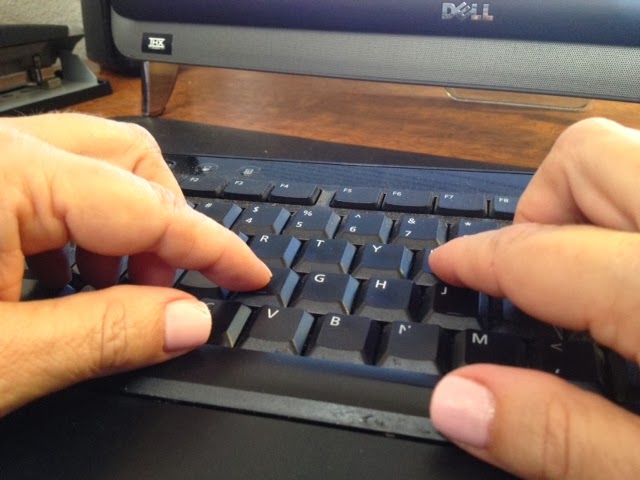
Months later I sat in front of my computer wearing purple and blue casts. It took weeks to figure out how to type again. I learned to punch the keyboard with my index fingers while resting both casts on a pillow and balancing ice packs on the back of my wrists.
Bored, restless and bored again...I got an idea for a story and haven't stopped writing since. And that's how I became a speculative fiction writer. It wasn't for a couple of bad breaks, I'd still be painting.
Read BJ Leesman's story The Little Man Who Wasn't There in the October issue of Penumbra EMag.
Thursday, October 3, 2013
The Chill of Discovery
by Randal Keith Jackson
It's a wonderful, crazy time to be alive. The current state of scientific knowledge is advancing almost as fast as the universe is expanding. On any given day, just read the science newswires and you'll find something that might have made Isaac Newton's head spin.
But for me, within the daily parade of science epiphanies, there is also … a dark side. Some of the new stuff we're learning about our world and universe kind of freaks me out. To wit:
The multiverse theory. If theoreticians are right, our universe is just one of an infinite number of universes. And in that infinite set of alternate universes, every conceivable variation is being played out (as long as it obeys the laws of physics).
For just one example, among those many universes, there is one with no extra period at the end of this sentence..
Everything else in that alternate universe is exactly the same, except that tiny period simply isn't there. And there is also another universe where there's a semicolon instead. And yet another one where this blog doesn't exist because I was hit by a bus on the way to work. And so on. Creepy, isn't it?
Slime with memory. When food is plentiful, a slime exists as a single-celled organism. But when food is scarce, they congregate and hit the road. The tribe crawls along, amoeba-like, at the rate of about an inch per day, in search of chow.
These lovelies may resemble vomit and have no brains, but incredibly, new research shows that they have memories, of a sort. Slime molds secrete a viscous, translucent substance as they move, which they use like a breadcrumb trail to remember where they've been. This information helps them negotiate obstacles and find things. In an experiment, researchers hid a sugary meal inside a simple maze, and a slime mold found it by using its trail to figure out where it had already been. Thus, it was able to find the food faster.
These molds might not be able to solve Fermat's Last Theorem, but I'm pretty sure they could find their cars in a mall parking garage faster than I can.
Rogue planets. Have you heard about the nomad planets? Planets without stars that just wander aimlessly through the universe?
I'm not making this up. In 2011, a group of astronomers reported the discovery of 10 such planets roaming our galaxy, apparently unhitched to any star. But the finding was not surprising; computer simulations of planetary dynamics show that interactions between planets within a solar system are likely to fling planets out into interstellar space on a regular basis. It may have even happened during the formative stages of our own solar system.
And astrobiologists tell us there's no reason to assume such planets couldn't support life; an Earth-like rogue planet could have liquid oceans if the water were heated from below by the planet’s core and insulated from above by a thick layer of ice. Even if Earth were suddenly tossed into interstellar space, it would be able to sustain some of its microbial life because of the heat that comes from inside the planet.
But here's the most unnerving part of all: These eerie drifters are probably common. Astronomers think there are billions of them in our galaxy. In fact, free-floating planets may outnumber what we think of as "normal planets." Gaaaa!
In the next few months, I'm planning to write at least one short story based on these unsettling prompts. How about you? Have you come across a scientific discovery lately that completely freaks you out?
Find out more about Multiverse theory, slime memory, and rogue planets.
In some universe, Randal Keith Jackson is an Icelandic haddock fisherman. But in this one, he's Internet manager at NASA's Jet Propulsion Laboratory.
His first published short story, "All the Devils," appears in the October 2013 issue of Penumbra.
Thursday, September 12, 2013
Daredevil Author
by Andrea Colasanto
Sonny Whitelaw.
Yep, that Sonny Whitelaw. Author of the Stargate novels, winner of the Draco Award—and soon to be a Musa published author with a new edition of The Rhesus Factor, available December 20th!
When Sonny’s not writing, she can be found exploring all the wonders New Zealand has to offer. Here she is being awesome, exploring caverns on Fox Glacier.
Working with Musa will give Sonny a wider audience in an e-publishing format. On her website, she mentions her Stargate novels are not available in New Zealand, where she resides. Musa Publishing will ensure that The Rhesus Factor will be available at the fingertips of all who wish to access it, anywhere!
Below is an excerpt from an interview with Sonny—you can read it in its entirety in the upcoming October issue of Penumbra EMag, so be on the lookout!
Sonny, were you a fan of the Stargate television series before writing the proposal for the novel?
Honestly? No. Not because I didn’t like it, but because I didn't see a television for two decades (aside from the odd trips overseas). But when I saw the movie, I loved the premise because back in the 1970s, I’d been intrigued by how the nineteenth century alien-gods-built-the-Egyptian-pyramids notion had escaped eighteenth and early nineteenth century science fiction and insinuated itself into pop culture and pseudo science. Back then, I thought it would make a great modern science fiction tale (after all, James Cameron turned Pocahontas into Avatar). The storytelling potential of Stargate was unlimited because it could capture every mythology from every culture for the past 10,000 years of human history, plus any number of aliens on unlimited planets. So yeah, when offered me the chance to play in their sandpit, I leaped at the opportunity.
Why do you think speculative fiction is so successful?
I wrote my second Masters thesis, The Attraction of Sloppy Nonsense, on that very question! (If by any chance anyone is vaguely interested, just Google the title). By its nature, speculative fiction explores and often challenges the human condition. It pulls apart what we believe, including our mythologies, and exposes the potential moral quagmires that science and technology are creating. That’s the storytelling side of speculative fiction. When it comes to movies and television, mind-blowing special effects breathe life into stories that many people would never normally read, if only because they don’t have time. Gaming takes it a step further: take great stories, add science fiction and a user interface, and even the most unadventurous can become immersed in fabulous tales set in realistic worlds without leaving the safety of their room.
As an author, what is your take on e-publishing and what it means for a changing market?
E-publishing has certainly come of age. I haven’t read the latest statistics but the last time I looked, around 60% of sales through some of the big name international print publishers were e-books. And many are struggling to compete with e-publishers who’ve been around for a while and have embraced the market and technology and run with it. Indeed, a top New Zealand publisher has just been forced to close, citing competitive pressure from e-publishers, and particularly self-publishing. While self-publishing is certainly taking a chunk of the market by virtue of the sheer volume of works out there, there is little or no quality control in the finished product. Readers quickly learn that if they want a quality product, they’ll buy from quality e-publishers.
What can you tell us about the upcoming The Rhesus Factor?
I'll let two reviewers explain:
Cause and effect, and for every action there is an equal and opposite reaction. Those principles are commonplace and indisputable. The Rhesus Factor by Sonny Whitelaw demonstrates with painful clarity that we ignore cause and effect at our peril. Perhaps the most frightening book of recent years, Whitelaw's thriller builds an all too plausible scenario of what might happen should our ecosphere decide to apply an equal and opposite reaction to our actions.
Fast-paced and grounded in solid research, the book charts not only the breakdown of ecosystems in the wake of global warming, but the breakdown of society that will be an inescapable result. It is precisely in the devastating detail of the wreckage of everyday life that the book is at its most explosive. While Joe Voter may dismiss global warming as a theory that doesn't affect him, the very real prospect of losing home, livelihood, educational facilities and medical care is bound to strike a chord. - Dr. Sabine C Bauer
Although fiction, I now know that some of the events in the book could happen in the future. The effects of global warming are evident, as is how this has put stress on the world, leading to world events that include terrorism, environmental vandalism and a lifestyle that we do not want for our future generations. I encourage all members to buy this book when it becomes available. - Barbara Stone MP for Queensland, Australia. (Excerpt from speech to Queensland State Parliament).
~~~~~~~~~~~~~~~~~~~~~~~~~~~~~~~~~~~~~~~~~~~~~~~~~~~~~~~~~~~~~~~~~~~~~~~~~~~~
Check back again for more information on the new edition of The Rhesus Factor by Sonny Whitelaw releasing December 20th!
Tuesday, September 10, 2013
On the Cusp of Science Fact and Fiction
by Randal Keith Jackson
Like most writers these days, I have a day job. And as a writer of speculative fiction, I could do a lot worse: I work at NASA's Jet Propulsion Laboratory.
It's like camping out on the fuzzy border between science fact and science fiction. I mean, this is a place where SF story ideas lie strewn on the ground like gold nuggets, waiting to be picked up and smelted into narrative. Here's a small sampling of the mind-bending discoveries in which JPL has played a role in recent years:
• More than eight-hundred new planets have been found beyond our solar system, some of them weirder than anything dreamed up by the creators of Star Trek.
• Interplanetary probes have returned pictures of vast methane lakes on Saturn's exotic moon Titan.
• Satellites have revealed mysterious, tantalizing cave openings on the surface of Mars.
• Spacecraft have photographed cryovolcanoes on the Saturn's moon Enceladus that spew fountains of ice hundreds of miles into space.
• Scientists have found mounting evidence that a vast, salty ocean swirls just below the ice crust of Jupiter's moon Europa.
With such rich fodder to draw upon, you'd think I'd write some science fiction, right? Well, for some reason, when I sit down at the computer after-hours to tell a story, my imagination always seems to turn in a different direction. I write about what makes people tick; the riddles, mysteries, and occasional ghastliness of human behavior. My muse wants to explore inner worlds. So I write psychological thrillers and horror.
But it's tricky; I have to be very careful that I keep the two worlds separate. Day job: robots, planets, and space. Night job: Psychopaths, monsters, and ghosts.
I mean, we can't have a story about sociopaths living in a haunted Victorian mansion that overlooks the icy fountains of Enceladus, can we?
Then again … that actually sounds kind of cool. I'll have to think about that one.
Randal Keith Jackson is an Internet Manager at NASA and a produced playwright. He's originally from Georgia and now lives with his wife and son in Santa Barbara, California. He has been known to rescue neighbors from snakes and build elaborate Halloween experiences in the garage. His first published short story, "All the Devils," will appear in the October issue of Penumbra.
Thursday, September 5, 2013
Maintain Your Balance
with David Elliott
How do you find the right balance between dialogue and action in a short story? Is there a trick to it or is it different for every story?
With action, as with dialogue and description, it’s knowing how much not to write. For example:
Brian woke up at 7:36 AM. He closed his eyes against the glare from the bedroom window, opened them again, closed them again, opened them, closed them, opened them, closed them, opened them, closed them, and then, finally, kept them open for at least four point three seconds before experiencing his first blink of the day. Giving his scrotum a satisfying scratch with the index finger of his right hand, he let out a brief but comedic fart, yawned with an ‘Eeeeeeraw’ kind of sound, and started to get out of bed. He threw the duvet aside with his left arm, planting his feet on the carpet, thus enabling his torso, arms, neck, head, eyes, nose, mouth, and ears, to rise from the mattress and greet the new day. Putting one foot in front of the other, right leg after left leg, in a motion that could only be described as ‘walking’, he headed towards the bathroom; a journey that took him five steps, including a sharp right turn. Taking the toothpaste in his left hand, toothbrush in the right, he squeezed out five point seven millimetres of blue sludge on to the two thousand and fifty three bristles, lifted the brush to his mouth, and painstakingly scrubbed each of his teeth: third molar, second molar, first molar, second bicuspid, first bicuspid, cuspid, lateral incisor, central incisor. He was just about to start on the opposite side of his upper mouth, when his Mother’s voice came floating up the twelve luxuriously carpeted stairs from their tastefully decorated hallway.
‘Brian? Are you up yet?’
Far too much action, in my humble opinion. Not to mention description. However, if Brian – in the context of the story – was to have a bad case of Obsessive Compulsive Disorder, this passage might actual work.
On the other hand, you could have something like this:
‘Yes, Mother,’ said Brian. ‘Of course I’m out of bed. But then you’ve never really cared about me, have you? You cold-hearted bitch. Well, if you think I’m going to stand here, with only a quarter of my teeth brushed, and let you stick your bony, black-headed excuse for a nose into my private affairs, then you’re very much mistaken. I’m a fully grown man! Do you understand? A human being, with thoughts, desires, passions, ideas. And you’re stifling me, Mother. Do you understand? Suffocating me!’
‘Oh,’ said Mother. ‘Sorry. Would you like a cup of coffee?’
‘Coffee? What good is coffee when there are children starving in the world? How can you possibly talk about frothy hazelnut cappuccinos lovingly dusted with chocolate, while people are being systematically raped, murdered, and persecuted, all because of the colour of their skin, their sexuality, their religious beliefs? Answer me that, Mother, if indeed you are my Mother! Coffee? I spit in your coffee, and urinate on all who’ve been involved in the manufacturing of your sickeningly sinful brown dust!’
‘How about a cup of tea then?’
Brian has quite a lot to say for himself here. Too much, in fact. On the other hand, if Brian’s character is that of a pretentious, opinionated, ungrateful maggot of a son who deserves a good hard slap with a wet fish, then these examples of dialogue might well be appropriate.
So, how do you find the right balance between action and dialogue?
Erm … I’m not really sure. Sorry. I think it depends on the writer, the story, the characters, and what kind of effect you’re looking to create.
I hope you weren’t looking for a short answer to this question.
David Elliott was born in Liverpool in 1981. In addition to Penumbra, his short fiction has been published by journals such as The Rusty Nail, Eunoia Review, Danse Macabre, The Satirist, Apocrypha and Abstractions, Down in the Dirt, The Horror Zine, Linguistic Erosion, Flashes in the Dark, MicroHorror, Twisted Tongue, and Delivered.
Tuesday, September 3, 2013
The Juggling Act
with Randy Henderson
How do you find the right balance between dialogue and action in a short story? Is there a trick to it or is it different for every story?
Next time you're reading while tired, notice how you read. Quite likely, you skim dense paragraphs of description, but never skip dialogue, and rarely skip action sequences. This is because what most often engages readers and carries them through a story are the characters' journey and actions, not the description of the scenery, or the exposition or historical notes, etc. (as cool as these things can be).
The implication is that dialogue covers, or at least signals, all the really important bits – the dramatic bits, the revelation of plot points, and where the character is expressing something, revealing their thoughts and feelings, their desires and fears, their intentions and regrets. Dialogue also reveals conflicts and connections between characters, and expresses the tension of the plot. Dialogue that is not doing any of these things, then, dialogue that is mundane or thinly veiled exposition, is a prime candidate for the waste bin.
On the other hand, you shouldn't try to put everything into dialogue. Your characters may begin to seem like little more than puppets there to mouth the author's As You Know Bob infodumping and plot explanation. Action has its place, to manifest in the physical world the character's motivations (including sometimes the desire simply to survive, though this is actually a weak motivation story-wise). And without setting and description, we cannot visualize who is speaking, or where they are speaking, or what they are doing as they speak.
So let the characters say what these specific characters would naturally say given their situation, feelings and motivation (shaped by their personality, background, etc.), and share with the reader only the most interesting and relevant things said. Let the action, the description and narration say the rest.
To blur the lines a bit, you can also have non-verbal dialogue, conveyed through actions. And dialogue itself is action since something is happening, and that something is ideally dramatic, and possibly filled with conflict and tension, and moving the story forward. You can slice someone with words as surely as with a sword. In fact, it is quite often more memorable and enjoyable to the reader if you do.
Ultimately, though, dialogue and action in genre fiction are really just different aspects of the same thing – ways to move the story forward in a dramatic way, ideally with some form of tension.
In other words, it is what underlies the dialogue and action that is truly important, and will tell you if you are sharing the right bits of dialogue and action, and if those bits are conveying what you need them to.
What is it that should underlie the dialogue and action? The motives and needs of the characters. The characters should want and/or need something in every scene, and their words and actions are their way of trying to get it, or of dealing with the aftermath of being thwarted in getting what they want or need, and forming new plans to get what they want or need. If we care about the characters and whether they get what they want or need, then the dialogue and action become meaningful to us.
On a more technical level, you can use dialogue and action to control pacing. Dialogue tends to speed up the pace, as does action sequences written in short, active sentences, while dense and lyrical narrative slows it down and gives the reader a breather before pumping up the adrenaline again.
And finally, yes, every story does have its own tone and style, and the uses of dialogue and action reflect that. For example, a romantic fantasy may be heavy on banter and barbs between the characters, allowing us to share in the growth of their relationship, while an urban fantasy story may be heavy on the narration and action scenes but with short snappy dialogue.
For my Penumbra story "The Beloved Changeling Who was Neither", I imagined the story being told by an old man in an Irish pub to find the story's voice and style. In such narrated tales, and in most first person or omniscient fiction, the narration itself is a kind of dialogue between the narrator and the reader, reflecting the narrator's voice, and following the rules of dialogue more than the formal rules and restrictions of second, tight third or omni narration.
My closing thought is to read your work out loud. It is the best way to catch false dialogue, or areas of too-dense narration, and issues with pacing and balance.
Happy writing, folks.
Randy Henderson's fiction can be spotted frolicking in places like Penumbra, Escape Pod, Realms of Fantasy, Every Day Fiction, and anthologies. He is a 1st Place winner of Writers of the Future, a Clarion West graduate, a relapsed sarcasm addict, and a milkshake connoisseur who transmits suspiciously delicious words into the ether from his secret lair in Kingston, Washington.
Learn more about Randy Henderson on his blog Smorgh is Bored. Stay connected on Facebook and Twitter.
Thursday, August 1, 2013
When Animals Speak
by Edoardo Albert
I have always been vaguely surprised that animals don’t speak. Maybe I am unusual in this, but I believe my reaction, on being addressed by a cat or spoken to by a dog, would more likely be relief that I had finally been let in on the conversation rather than amazement at their speaking. And it’s not just cats and dogs either – the last few, sweaty hot nights have seen me sleeping with windows thrown wide, only to be roused from the fitful slumber of the early hours by the extraordinary racket set up by the birds at four in the morning. There’s definitely something going on in the avian world that they keep to themselves, relying on slugabed humans not being awake to hear.
Nor would I stop at animals, be they feathered or furred. Who has walked at twilight through a wood, when the wind gets up as the sun goes down, and heard the creak of timber and the hiss of leaf and not thought, with a twinge of mingled excitement and fear, that the trees are speaking of the day. Although the idea of the music of the spheres now seems ridiculous, how much is this down to the haze of light saturating our cities and excluding all but the brightest stars from a sky that is no longer black but a neon grey. The city nightscape is a dull, closed in bowl. But on those occasions when I have been beyond the reach of artificial light, and innumerable stars have arched across the sky and the night has been so black I could not see my own feet upon the road, then the idea of crystal music reverberating around the heavens seems considerably less outmoded. I suppose the distant receding echo of the creation that suffuses, well, everything is the drone over which the stars and galaxies weave their harmony. Honestly, sometimes it seems that all creation is engaged in one giant conversation from which we alone are excluded. ‘For everything that lives is holy’, as Blake said, to which we might add it’s busy talking too!
Of course, the question is why we are excluded from the conversation of creation. In CS Lewis’s Space Trilogy, the Earth, Thulcandra, is called the silent planet due to the revolt of its presiding spirit against the presiding spirits of the other planets. However, that does not really address why we are excluded from the conversations of the creatures that share our world. Moving from biology and astronomy to mythology and folklore, stories and legends from throughout the world and almost all eras attest to creatures talking to us: elves, dwarves, djinn and devas, the list is long, the conversation not always edifying – interviewing a vampire only recently becoming something desirable – but for most of human history it has been ongoing. Until now. The last century or so has seen a trickling away of such stories. There has been the odd, overly intimate, encounter with aliens, but the beings whose worlds used to intersect with ours have retreated. We live alone in a world gone silent. The question is why.
Having dragged you this far, it would be a pretty poor show if I didn’t at least attempt an answer, so here goes. The world has not fallen silent. The animals and birds speak, the creatures of legend and myth walk their shadow paths, but we are too preoccupied, too caught up in our own endless chatter, to hear or to see. As we have been able to talk more, through letter, telephone, television and now, ceaselessly, online, all other conversations have been drowned out. The human party has grown too loud and rowdy to allow anything else a voice. It is indeed a wonder of our age that we should be able to talk across the world but in doing so we, necessarily, tune out everything else. Returning to our human party metaphor, talking to someone there requires the suppression of everything else: concentration and exclusion. Our whole world is a cacophony of competing human voices. To hear any of them – to keep from going mad – we have to concentrate and exclude. Is it any wonder then that we can no longer hear other voices, and tune in to different conversations?
So, and pace the wonderful people at Penumbra, my suggestion is this: switch off your computer (or phone, or iPad). Turn off the television. And listen. You never know what you might hear. There are all sorts of conversations going on around us all the time. Falling silent ourselves allows us to eavesdrop on them. And, who knows, if we listen, quietly, patiently, politely, they might, in time, include us in the conversation again.
This is the road less traveled in human history: the one taken by the quiet ones, the hermits, the monks, the people who see the overgrown path leading up to a cleft in the hill and take it, the ones who shut the door against the noise of the city and listen to their walls breathe. Uncomfortable, uncomforted people, garnering little sympathy in our compulsively sociable world. There is no guarantee in such a journey. The path might peter out, the walls become a prison, but still and still…
Listen. Close your eyes. Listen.
Who knows what you might hear?
The responses to Edoardo Albert’s work rather prove what he argues. The stories, the books, the articles, have drawn some compliments, but the best response ever, which saw a friend rolling on the ground, helpless with laughter, was a lonely-hearts ad. It was probably the bit about tickling the belly of a wolf that did it.
Find Edoardo Albert’s books (he’s particularly proud of Northumbria: The Lost Kingdom) and stories via his website although the lonely-hearts ad will not be making an appearance in the foreseeable future. Connect with him through his blog, Twitter or Facebook.
Tuesday, July 30, 2013
A Moment with Alex Gorman
When and why did you decide to pursue writing as more than a hobby?
This question made me feel like my first college roommate. He and I were both in a writing class, one that every freshman was required to take. He’d sit in front of his computer to work on each assignment, only to find himself staring at the blinking cursor on the screen, unable to think of a word. Meanwhile, a few feet away, I’d be happily tapping away on the keys, the paragraphs just flowing out of me.
I know on at least one occasion, he mentioned how much this made him hate me.
As I tried to come up with a response for this post, I found myself sitting in front of my computer, staring at the blinking cursor. So I stopped trying to answer the question and spent some time thinking about it. I quickly realized that I’ve never had a moment where I decided that writing should be more than a hobby. I’d never considered writing to be a hobby at all. It’s just something I’ve always been compelled to do. The stories start to form in my mind and it’s my job to catch them, to find the right collection of words that traps them on the page. Sometimes this is euphoric, sometimes it’s a slog.
The closest I came to having a moment of decision about writing was around my mid-twenties. I had decided that I had other priorities. I chose not to focus as much energy on writing stories. I still wrote a little, blogging, doing a few articles for soccer websites, things like that. But those only offered me a partial outlet. The ideas kept building up. So I found myself leaving behind a trail of incomplete stories even during those years when I thought I didn’t want to write.
Maybe I’d decided to pull back, as young adults often do, because I was a little afraid, more of failing than of putting myself out there. Not too many people pay the bills with the written word, after all. It took a little growing up for me to realize that it wasn’t about paying the bills. It was about the stories, about learning and improving and becoming a better writer, so I could really bring those ideas to life.
The reality is that I’ve let hundreds of story ideas go, uncaptured. Some because I was too lazy to write them down, others because they never became more than a note on a scrap of paper, many because the words just never came together into a story I thought was good enough.
For those few stories that actually make the journey from idea to completed work, keeping them to myself was never really an option. I think if I considered myself a hobbyist, I’d be okay with not sharing them. But I’ve always wanted my stories to be read. After all, a story only comes to life in the head of the person reading it. I want my stories out there, moving in the world, interacting with people and helping create new ideas.
Alex Gorman lives in sunny San Diego with his wife and two children. He writes maniacally and has had work published in Big Pulp, the Triangulation Anthology and the Kazka Press.
Learn more about Alex Gorman and his adventures on his blog Nonsensicles.
Thursday, July 25, 2013
A Moment with Hannah Adcock
When and why did you decide to pursue writing as more than a hobby?
I always wanted to write, or at least to make stories, since I was about six. Maybe even five. I was obsessed with rewriting fairy tales, and my own versions of them were, looking back, quite grisly. For example, Goldilocks would find Baby Bear lost in the woods and then raise him…only to have him turn around and eat her once he was big enough!
My first audience (who were my nan and mum) would read these stories and be going, “Why so gory? What did she do to deserve that?” - and laughing - and I’d say, “’Cause it’s funny.”
The urge to write came to light around the same time I got the urge to make people laugh. It was only when I started to read the Roald Dahl books, and the Beatrix Potter books, and then a little later the Narnia series by C.S. Lewis, that I began to get the idea you could actually do this for a living. It was like, “Hey - wait a minute. These people are adults…and they get paid to scribble down whatever they’re daydreaming about?…I want to do that!”
I wasn’t sure how. I still wrote, though. My first novel, aged seven, was a farcical story about a family of rabbits who constantly fell out and beat each other up. From then on I was known, by close relatives, as ‘Potty Beatrix’ until I abandoned that particular book. (If you can call all of fifteen pages a book.)
I didn’t try to write a proper book again until I was just finishing my GCSEs. I have to confess, whatever opportunity I had, I’d whip out my notebook and start scrawling when I should have been revising…not in ALL my lessons, of course…how the teacher never noticed I’ll never know. But the fact is, I wanted to write more than anything else, and this was because it was about the only thing I could do well, (apart from wonky comic strips which haven’t seen the light of day). It was like swimming, or flying. Brilliant.
So, I typed up the novel, which was going to be a fantasy novel for older children - dead chuffed, had it all set up in my head - and, aged sixteen, I posted it to a publisher. And I had no idea what I was doing. No idea of how the publishing side of things worked. I was flying, yes - but by the seat of my pants.
They were very nice about it. I got a long letter back giving me words of encouragement and some suggestions about what I should try first before actually spitting out a book. Still kept the letter. I have it lurking somewhere in a frightening corner of my drawers. (Chest of drawers, in case you were wondering.)
After that I left it again for another couple of years. Did my A-levels, reasonably well, but by that time I’d decided I didn’t want Higher Education. I wanted to get off the treadmill and just get on with work. I thought I’d be a pre-school teacher and went on a childcare course for all of six months, and thought, “These people are all right, but I don’t belong here. This isn’t for me.”
So, I set out to learn a bit more - finally. I did a short course in creative writing with the Open University, read An Author’s Guide To Publishing by Michael Legat (written in the days when they still used typewriters, but still interesting), got the Writers and Artists’ Yearbook, and it was like, “Oh!” (slaps forehead) “That’s how it works! You send shorter stuff to magazines!”
I’ve been doing just that (as well as poetry) for almost a year now, and I’m overjoyed to say it’s working.
Hannah Adcock is a writer of fantasy, sci-fi and poetry (often with a humorous bent)living in a strange corner of Lincolnshire, England. Her work has appeared in Poetic Diversity, Clockwise Cat and Penumbra. She posts poetry, artwork and other oddments over at inspirationandlaughs.wordpress.com.
Learn more about Hannah Adcock her Facebook author page.
Tuesday, July 23, 2013
Roger Rabbit at Comic-Con 2013!
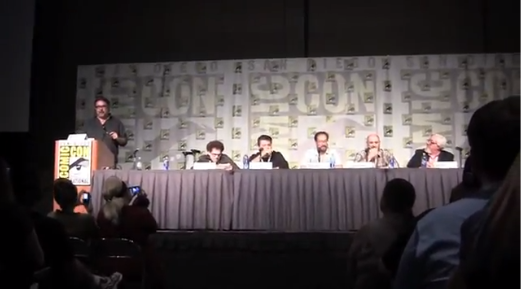
Comic-Con 2013 took place this past weekend in San Diego, and included a panel on the making of Who Framed Roger Rabbit?. The beloved animated movie based on the work of author Gary K. Wolf is celebrating its 25th anniversary this year, and the panel was led by a world class group of animators including producer Don Hahn, animation masters Andreas Deja and James Baxter, writer Tom Sito, special effects guru Dave Bossert, and a special appearance by the voice of Roger Rabbit himself, Charles Fleisher!
There is an audible buzz of excitement throughout the audience for the entirety of the panel, and served to be a great opportunity for fans wanting to discover the ins, outs, trials, tribulations and accomplishments of Who Framed Roger Rabbit?, both during its making and afterwards.
The panel begins by paying homage to Gary K. Wolf, who of course without his novel Who Censored Roger Rabbit?, there would be no script for the movie. The panelists then discuss how Who Framed Roger Rabbit? was one of the first movies to be a hybrid, which combines live action with animated character. At the time (1986), digital technology hadn’t progressed to the point of being even half as fast as it is now, so the movie shines as a “hand painted” work, where every facet of the animation is pure hand creation.
Charles Fleisher, the voice of Roger (as well as Benny The Cab, Greasy, and Psycho), seems very Roger-esque to this day. He hops around on the panel—alternating between sitting, standing, and cracking jokes. He also performs his Roger Rabbit voice after an audience member requests it at the drop of a hat, and it is still flawless, twenty-five years later!
Jessica Rabbit. You knew we were headed there, right? The panelists discuss how Rita Hayworth and various supermodels were inspiration for her. In fact, the animators would have supermodels come into the studio to walk and pose in order to capture an essence of Jessica on paper. Her main animator, Russell Hall, was very quiet and shy according to the panelists, and had a very hard time with her character at first. That is to say, he couldn’t quite bring her to life until he ultimately “exaggerated certain parts of the anatomy” (panelists words!). His routine was to smoke incessantly, get up and move about rather sensually around his office, then get back to his drawing board, never breaking focus. And for this quiet, chain-smoking man who danced solo around his office, we thank you for Jessica Rabbit!
The panel concludes with questions asked by audience members (one woman dressed in impeccable Jessica garb!). The best answer comes from Charles Fleisher, who when asked “How would Roger Rabbit react with current video game characters like Sonic the Hedgehog, Mario, or Optimus Prime?” responds with “He would destroy them all by making them laugh, and then stealing their batteries.”
Well said.
To watch the You Tube video of the Who Framed Roger Rabbit 25th Anniversary at San Diego Comic Con please click HERE.
Remember to be on the lookout for Gary K. Wolf’s new novel in the Roger Rabbit series, Who Wacked Roger Rabbit? available for pre-order by Musa Publishing on October 22nd, and for release on November 22nd! And be sure to check back here for any Roger related news!
Thursday, July 18, 2013
A Moment with J.M. Scott
When did you first become interested in writing?
I became interested in writing fiction when I was at San Francisco State University. Between classes, I had a lot of down time, so reading more than just my text books became a standard practice. I’d spend many foggy afternoons enjoying the works of authors like Peter Benchley, Michael Chrichton, and occasionally, Stephen King. I respected their creativity, but at that point in my life, never thought that I would try to write my own stories.
During my senior year, I took an advanced screenwriting course. It was very educational but extremely labor intensive. The instructor wanted a completed script by the end of the term. Needless to say, I spent countless hours penning my screenplay. When it was time to turn in the assignment, only a few students had completed the work. The sheer volume of the project had disenchanted many of my fellow writers. It was then that I thought I might have the qualifying skills to merit publication. I wrote a couple science fiction pieces and eventually sold one to an online magazine. That same summer, I was hired as an English teacher at a local high school. I was very enthusiastic about my new job, so I went back to earn a master’s degree in Education. Unfortunately, because of the demands of my fledgling career I had to place writing on hold.
Over the years, I’ve had the opportunity to read and teach many incredible works of literature, but I always felt that there was something missing. Most English teachers appreciate and critique the written word often, but few make an attempt to publish work for other people to read. It became important to me to show my students that I could demonstrate the skills that I was teaching them, so one fateful day I started typing.
I made every mistake in the book, but after two years of believing in myself and listening closely to editors and other trained authors, I started to find some success. I finished my first novel, Tarus Falls, and was able to write several short stories that are either out for consideration, or have been published.
I enjoy the craft immensely and still get excited when I take a course or purchase a new book on writing. Optimistically, I’ll continue to learn with each word that I press onto the page, and with a little luck, build a readership that will enjoy my work for years to come.
J.M. Scott is a writer from Fremont, California. When he is not working on his next story, he enjoys an active life of scuba diving, Aikido, and amateur marksmanship.
Subscribe to:
Posts (Atom)