Showing posts with label Northumbria: The Lost Kingdom. Show all posts

Tuesday, October 22, 2013

HAPPY BIRTHDAY!

by Edoardo Albert

In honour of Penumbra’s second birthday, and without the slightest (well, hardly) intention to ingratiate myself with its editors, may I say that this is undoubtedly the friendliest and most professional magazine I’ve dealt with. Penumbra pays well, looks marvellous, responds quickly and, apart from publishing my stories, provides me with this free soapbox to advertise myself and my wares. What’s not to like? And, more importantly, long may it continue, particularly if it publishes more of my stories.

Dianna Gunn, intern par excellence, asked me to write something about what I’ve been up to since appearing in the magazine (since you ask, the Revolution and Exploration issues) and it just so happens that I have my first novel due out next March.
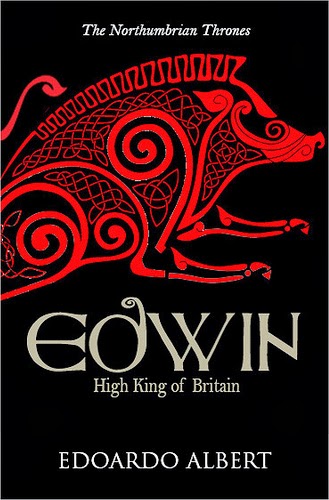
It’s only taken me thirty-two years to get to this stage! Anyway, Edwin: High King of Britain was a result of the research that went into writing my book, Northumbria: the Lost Kingdom, on the history and archaeology of one of the key Dark Ages kingdoms of England (although, of course, England didn’t actually exist then). The story of the three successive Northumbrian kings whom the Venerable Bede accords the title bretwalda – that is High King of Britain – seemed so extraordinary I was astonished that nobody had written about them before. So I decided to.

One of the advantages of doing things this way round was that I had already done most of the historical research necessary – it was just a matter of trying to bring it all to life. Hopefully I have done so, it would be a grave discourtesy to some extraordinary but all but forgotten people if I haven’t. The book will be published by Lion Fiction in March. The publishers, spotting a link, have given the trilogy the overarching title of The Northumbrian Thrones but in truth, there really was something very like a game for thrones going on in the bloody, violent but extraordinarily creative kingdoms of seventh-century Britain. The foundations of England were laid, amid historical darkness, in a time when the only certainty for a king was a violent death. And yet, perhaps because of the very precariousness of the times, these men and women created things, such as the Lindisfarne Gospels and the Sutton Hoo jewellery, of quite extraordinary beauty. While in some ways the kings of the Early Medieval Period (the preferred academic term today) were like Mafia dons, enforcing protection rackets on their subjects, yet the culture they created and their sensitivity to language were as far removed from the profane and profanity filled life of a John Gotti as it is possible to be.

To do such times and such people justice is no small task. I can hardly hope to have succeeded, but at least I hope not to have failed.

Edoardo Albert is, on paper at least, a surprisingly exotic creature: Italian, Sinhala and Tamil by background, he grew up in London among the polyglot children of immigrants (it was only when he went to university that he actually got to know any English people). He avers that he once reduced a reader to helpless, hysterical laughter. Unfortunately, the piece that did so was a lonely-hearts ad.

Find Edoardo Albert’s books (he’s particularly proud of Northumbria: The Lost Kingdom) and stories via his website although the lonely-hearts ad will not be making an appearance in the foreseeable future. Connect with him through his blog, Twitter or Facebook.

Tuesday, November 20, 2012

Where Is the Humour?

by Edoardo Albert

The future, it appears, has no jokes. Nor, for that matter, does the urban present, even if it is filled with glittery vampires. For some reason, speculative fiction appears to be almost completely humourless – think of the number of magazines, ezines, fanzines and geezines that advertise themselves as ‘dark’, ‘darker’ or ‘so bloody morbid we’re invisible at night’. Why is this? True, the old grandmasters of speculative fiction that I grew up reading, men like Robert Heinlein, Arthur Clarke and Isaac Asimov, were more concerned with imagining and, dare I say, propagandising the future than populating it with jokes (although anyone reading ‘The Number of the Beast’ would have to assume that Heinlein, at least, had a sense of humour since the alternative, that he seriously means this, is just too awful to contemplate). But surely now – when we live in a world with all the trappings of the wildest science fiction future in an everyday iPhone – it’s time to admit that the future is here and it’s completely and utterly ridiculous. I mean, what would the Futurians have made of a future that achieved technological miracles and used them to turn Paris Hilton into the most famous person on the planet?

In fact, all the prophets and soothsayers were wrong. Take George Orwell for example. Although he was correct in much, he saw the future as a boot stamping on a human face forever. Well, the future turned out to be a human face gurning forever. As such, maybe the reason there’s so few jokes in speculative fiction is because it’s pretty well impossible to top what’s actually out there. Imagine the most extreme ad absurdum you can, and someone will be offering it on eBay. After all, one young woman just auctioned her virginity for $780,000 and justifies it as a career move. You really couldn’t make it up.

Then why should you? The world is the most wonderful resource for the writer of the absurd and it’s there to be mined: after all, what could be sillier than sex, money and politics?

The temptation, of course, is to conclude that because we are absurd, as a species and a civilisation, then everything is. But that, it turns out, is a conclusion too far – there is nothing absurd in nature although there is much that is strange and grotesque. Absurdity is a human specific attribute, and one that grows more pronounced the greater our powers become. “Ye shall be as gods,” was the promise, and we are, wielding powers undreamed of, sufficient to make a paradise on earth. But, instead, we have the Shopping Channel. It’s an object lesson in unintended consequences. We could imagine Jehovah, standing by the gates of Eden, asking, “So how’s that god business shaping up for you?” It’s the job of the writer to answer, “Er, not so well.”

Edorado Albert's story Time Hoppers is featured in the November issue of Penumbra EMag.

The responses to Edoardo Albert’s work rather prove what he argues above. The stories, the books, the articles, have drawn some compliments, but the best response ever, which saw a friend rolling on the ground, helpless with laughter, was a lonely-hearts ad. It was probably the bit about tickling the belly of a wolf that did it.

Find Edoardo Albert’s books (he’s particularly proud of Northumbria: The Lost Kingdom which has just been published) and stories via his website although the lonely-hearts ad will not be making an appearance in the foreseeable future). Connect with him through his blog, Twitter or Facebook.