Thursday, May 30, 2013

Write What You Love

by Shannon Fay

The one piece of advice I would give new writers is to not just to write what you know but to write what you love. Maybe you love astronomy and have a head full of constellations, or you have a gift for languages, or you’re an expert in some field or hobby. These things that interest you, that take up your idle time, use these things in your stories. Your knowledge on the subject will give your story more credibility and your passion will give it life.

And the things you love don’t always have to be so specific. Maybe you love unconventional narratives and finding new ways to tell a story. Maybe you love rousing adventures that make the reader forget their troubles here on the ground. Or maybe you think often about how men and women relate to one another, or how parents and children relate to each other, or how people in general relate to each other. Figure out what interests you and cultivate it.

There have been times when I’ve grown stuck while writing, working myself deeper and deeper into a rut the like a wheel spinning in the mud. The most frustrating thing was that there was nothing technically wrong with the stories I was working on: the plotting was sound, the words at the very least in the right order, but there was something missing. I didn’t care. And why didn’t I care? Because I just didn’t care. There was nothing I loved in the story. Usually this happens because I’m so focused on writing something technically good that I stop writing about things I care about. Instead of following my passions I end up following trends, tapping into the popular consciousness rather than my own. And that’s when I get stuck.

There are stories only you can write. They might end up being very weird and/or personal stories, and they’ll probably be rejected a lot. But that just means that when they do connect with someone, the connection is all the stronger.

Write what you love sounds like obvious advice, and it is. In fact, new writers usually have a better handle on it than writers further along the path (in which case maybe this post should be about advice I’d give to ‘old writers’ instead of advice I’d give to new writers, not that I feel overly qualified giving advice to anyone). But it’s something that’s easy to lose sight of. So, even after you’ve written thousands upon ten thousands of words, remember what you love.

Shannon Fay is a freelance writer/assistant bookstore manager living in Halifax, Nova Scotia. She has recently won the James White Award and has had several short stories published in a variety of genres.


Learn more about Shannon Fay on her website.

Wednesday, May 29, 2013

How to use pearls, the Couture way

pearls, diy pearls, diy, runway,pearls,  fashion diy
Armani Privè 2009 via Pearls and Chains

Above you can see what king Giorgio does best, amaze! This is an outstanding top made of strands of pearls. 
The single strand of pearls around your neck is perfect for almost any occasion and it's so chic, but what's beyond it? What can you do with pearls (lots of them) and what can they do for you (make you look unique)?

Pearls are really popular this spring thanks to Chanel's big, chunky bracelets and necklaces (see how to DIY yours here).
Discover below what couturiers do with millions of pearls and an army of seamstresses.
Don't be scared! If you want to obtain some of these look you can skip the exhausting sewing hours  with a simple trick.


pearls, diy pearls, diy, runway,pearls,  fashion diy
Francesco Scognamiglio s/s 2011 via Theimportanceofclothes

pearls, diy pearls, diy, runway,pearls,  fashion diy
Diane Von Furstenberg spring 2013 shoes via TheLuxurySpot
pearls, diy pearls, diy, runway,pearls,  fashion diy
Acne ss 2011 via TheChicDepartment
High - low mix. Sporty proportions and delicate pearls.

pearls, diy pearls, diy, runway,pearls,  fashion diy
Victor&Rolf a/w 2001 via gidgetbowden

Ok these are more beads than pearls but the effect is stunning and it can be done with pearls as well.


pearls, diy pearls, diy, runway,pearls,  fashion diy
Alexander McQueen a/w 2009 via gidgetbowden
Baroque headpiece.

pearls, diy pearls, diy, runway,pearls,  fashion diy
Chanel s/s 2012 via FashionTelegraph
Pearls to decorate a bag.

pearls, diy pearls, diy, runway,pearls,  fashion diy
Balmain fall 2012 pic via babes in balenciaga
Balmain baroque dress. DIY your own Balmain inspired trousers here.

pearls, diy pearls, diy, runway,pearls,  fashion diy
Chanel fall 2010 pic via moodboard

Jewels for the body. Pearls give their best effect when they can move. See the beautiful swinging pearls on this dress.
pearls, diy pearls, diy, runway,pearls,  fashion diy
Chanel fall 2010 via moodboard
pearls, diy pearls, diy, runway,pearls,  fashion diy
Chanel fall 2010 via moodboard
pearls, diy pearls, diy, runway,pearls,  fashion diy
 Chanel fall 2010 via gidgetbowden
Pearls as sleeves.

pearls, diy pearls, diy, runway,pearls,  fashion diy
Anna Sui spring 2013 via stylebistro
pearls, diy pearls, diy, runway,pearls,  fashion diy
Chanel spring 2013 via parischerie
pearls, diy pearls, diy, runway,pearls,  fashion diy
Alexander McQueen fall 2013 via Vogue
Pearls on tights.

pearls, diy pearls, diy, runway,pearls,  fashion diy
McQueen spring 2012 via theimportanceofclothes
This effect could be obtained on a smaller scale with glue on flat back  pearls I think.

Tuesday, May 28, 2013

Bolts of Lightning

by Chris Pavesic

Speculative fiction has been a favorite genre of mine for years. I like the ideas in the fiction; I like the short story length. It gives a writer a chance to work on his/her craft; in essence, it gives a writer a chance to be a wordsmith.

Writing comes down to creating connections—making that momentary bridge between the writer and the readers—and those connections are made through words. In its basic sense, writing is a means of transmitting the thoughts and images that reside in a writer’s brain to a reader in the most effective and accurate fashion. In a letter to George Bainton in 1888, one of my favorite authors, Mark Twain, described the desire for this accuracy in the following way: “The difference between the almost right word and the right word is really a large matter--it's the difference between the lightning bug and the lightning.”

This is what I look for in speculative fiction—words or phrases that can make that connection between the reader and the writer with the force of a bolt of lightning. This is what I search for as a reader and this is what I strive for as a writer—the amount of impact that will make a story memorable.

Recently I had that “lightning bolt” reaction when reading Ken Liu’s speculative fiction story, “The Paper Menagerie.” A friend of mine had a similar reaction when reading Brian Grigg’s “Wendell, Custodian of the Galaxy,” published in the March, 2013 issue of Penumbra (a story that I really enjoyed as well!). What causes that “lightning bolt” reaction with a reader? I know when it happens to me as a reader, but it is something I continue to work on each time I put a metaphoric pen to paper.

Many of my short stories start out a great deal longer than their finished versions. I pare them down, looking for those essential words or phrases that will connote as much meaning to a reader as an entire paragraph. This is not an easy task; changing one paragraph can alter the entire meaning of the story. This is where multiple drafts come in, and why I am grateful for the technology we have today. I can save one version of a story, make changes, and go back to the first version if I prefer it with a mere click of a mouse button. (I almost cannot imagine writing and revising with pen and paper the way that Twain did!)

If all this goes well, I will create a connection to my readers with my words. They will interiorize the thoughts and images from my writing. They will see the characters, experience the emotions, and wander in the storyscape I create. We will have that momentary bridge of understanding, complete with a lightning bolt or two.

Chris Pavesic lives in the Midwestern United States and loves Kona coffee, fairy tales, and all types of speculative fiction. Her story, “Going Home,” is the featured story in the June, 2013 issue of Penumbra. Between writing projects, Chris can most often be found reading, gaming, gardening, working on an endless list of DIY household projects, or hanging out with friends.

Stay in touch with Chris on her blog.

Sunday, May 26, 2013

5 designers bring 5 manicure ideas

Chanel spring 2013 manicure, spring 2013 manicure trends, nails
Chanel spring 2013 manicure by Miss Lady finger

This Chanel suit is perfect. The proportions are young, colours are fresh, the grid is modern. Its manicure version is also interesting.

4 more nail  ideas after the jump.


Diego Binetti triple tiered pearl manicure, spring 2013 manicure trends, nails
Diego Binetti triple tiered pearl manicure via Huffinton post

Ok, this is very unpratical, but it's really different. I mean, who would have thought about stacked fake nails?
I had to show you.

Prada japanese flowers manicure,spring 2013 manicure trends, nails
Prada japanese flowers manicure by  MichelleOhtman

Kate Spade spring 2013, spring 2013 manicure trends, nails
Kate Spade spring 2013 via StyleBistro
There are a lot of stylish grid patterns this season but this one by Kate Spade is my favorite. It's simple and comes in bright colours, very picnic chic.

libertine fall 2013 manicure, spring 2013 manicure trends, nails
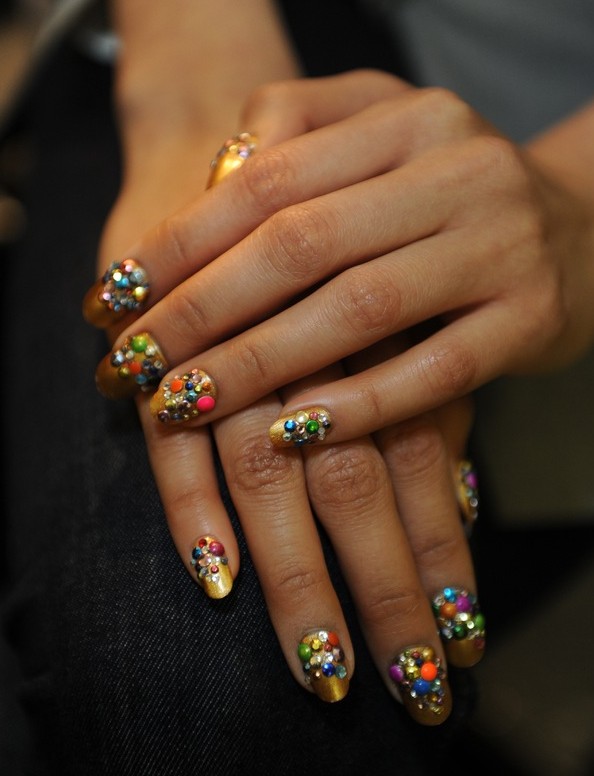
Libertine fall 2013 jewel mani via Huffingtonpost
Why not add studs to nails too? These nails decorated with rhinestuds on a gold base look like a byzantine jewel. Very precious!

P.M. GRIFFIN GOES LIVE!

Romance novelist Bernadette Walsh interviews science fiction and fantasy writer P.M. Griffin Sunday May 26 at 7:30 p.m. EST on Nice Girls Reading Naughty Books. Please stop in to cheer P.M. on.

To watch the interview live please click HERE or go to: http://www.blogtalkradio.com/bernadettewalsh/2013/05/26/nice-girls-reading-naughty-books--pm-griffin

Pauline (P.M.) Griffin's Irish love of story telling coupled with her passion for history, the natural world, and research have resulted in seventeen novels and ten short stories, two Muse Medallion Award winners among them, all in the challenging realms of science fiction and fantasy.

She lives in Brooklyn, New York, with her cats Jinx, Katie, and Nickolette and three tropical fish aquariums and devotes just about every 'spare' moment to writing, research, and reading.

To read excerpts from P.M. Griffin's books released by Musa Publishing, please click HERE.

Thursday, May 23, 2013

It's not the average sheer skirt, DIY it!


sheer skirt diy , diy skirt, diy, fashion diy, cut out skirt diy, transparent skirt, stella mccartney,
Sheer skirt DIY tutorial -DIY demanta bag - DIY walnut bracelet
diy, fashion diy, cut out skirt diy, transparent skirt, stella mccartney,
You can renew any skirt from your wardrobe. I sewed mine from scratch and I added a curved edge at the waist.

Featured in almost every spring collection, sheer clothes are a season must have. You can choose how much skin to show according to the occasion and your personal style. Get into the season mood and DIY your unique sheer skirt with a pair of scissors and some sheer fabric. Why shouldn't it be called an average sheer skirt? Because with this technique, that I also used in this man shirt makeover , you can cut the skirt wherever you want and there's no need of any pattern, you're free to make the skirt that you want! I'll show you how. I was inspired by Stella McCartney for the curved hems and the color combination. The skirt I used is a knee-length one made it more interesting by the sheer panel that goes behind the skirt.  Ready to renew a skirt from your wardrobe?


Liked this post?

See another DIY dress inspired by Stella McCartney 

See another sheer skirt DIY

See all the DIY skirts


Are You a Science Fiction Writer?

by John Deakins

Never mind what you write: what do you read? Scientists and technologists who never write SF themselves, read it continually. They may not always recognize bad writing, but they’ll immediately spot a scientific or logical blunder. Science fiction has a better educated readership than that of bodice ripper romances. Listen as your SF-reading friends rip into some recently released SF film. Want more readers? Your current readers can make your book by word of mouth, but those readers can kill your book the same way. The Ignore It approach to scientific road-blocks may not be enough.

Live With It

Science is cold, hard, and unyielding, but it won’t let you down on consistency. If you’re stymied by missing FTL drives, write a story with slower-than-light interstellar transport. If it’s too dangerous to land on an alien planet, create a way to make contact without landing. If you can’t use your time machine for time travel, use it for space travel. Real science happens all the time. Most of what happens within our solar system follows fairly simple Newtonian physics, never mind Einstein. That’s a huge canvas on which to paint your word pictures.

You have before you enormous possibilities within Science. Mars doesn’t have multiply armed green Martians, but what it does have is fascinating, even if it is hard, cold, and unyielding.

Unexplained Science.

You don’t have to explain how your SF technology works; you only have to name it. In fact, the more you explain it, the sillier your explanations will sound to anyone who actually knows science. Some stories need controlled time travel, faster-than-light speed, and the ability to smooze with aliens, but the smart author will tiptoe around hard-science details of exactly how those things are accomplished.

The biggest danger of unexplained science lies inside the writer. We know our science. “Unexplained” makes us itch. It’ll be hard not to yield to the pressure to throw in “subspace” devices or “tachyon pulses.” Hollywood pimps are eager for more “drama” in their SF. They know no science, but they’re full of hackneyed “science fiction” ideas. (Well . . . they’re full of something.) Their “science” explanations stink up the genre; flawed logic flows from mainstream media as from a ruptured sewer line. How easily unexplained science crosses over into partially explained fantasy! On the west coast, that’s a mighty thin line. Nevertheless, it’s a line that we shouldn’t cross.

It’s time now to take on the behemoths of science fiction. We’ll beat them into submission, and then harness them to pull our stories. The blogs that follow are full of story “hooks.” If one snags you, go with it If you get that literary gestalt, when a story leaps full-blown into your mind, quit reading this and write that story. When you do, you’ve made this work a success.

John Deakins, B.A., M.S.T. is a four-decade veteran of the science classroom and author of his own fantasy series Barrow.

To read an excerpt from Barrow book one, please click HERE.