by Brian Griggs
Anniversaries are a big deal. I don’t think that I need to remind anyone of the elaborate parties that werewolves host every full moon (they’re rip-roaring events, to be sure) and everyone knows that the exploding giants of Erb’durindian can bring the house down. Don’t get me started on how husbands on Shazbar 3 have no excuse for forgetting anniversaries even though the planet completes an orbit every 55 days. You and I know that, whether you’re a squidfolk, an automaton, or somewhere in-between, anniversaries are a big deal.
It should come as no surprise, then, that Penumbra’s anniversary is an event to watch. Rumor has it that Paulis is grilling up some sim-steak and galta-fish for the potluck. Kyr is bringing his patented pre-fab coffee, which I hear is to die for. And for the first time in a long time, Wendell, Custodian of the Galaxy, will not have to clean up the whole thing afterwards.
It’s a time to celebrate, a time to enjoy hanging out with characters from all branches of speculative fiction. Because where else can you find great homages to Ray Bradbury one month and then the next be immersed in the zombie apocalypse? If you’re a fan of the imagination, Penumbra is your place.
I’ve enjoyed having stories run in issues of Penumbra EMag and it’s not just because I love seeing my name on their beautiful covers (thank you, Celina Summers and Kelly Shorten!). I know that when I have a story in an issue of Penumbra, I know that I’m a part of something bigger than myself. Fans of speculative fiction who are fans just like me will read our stories. I know that it’s about the quality of the story, the believability of the unbelievable, and not limited to what some big corporation says is good. (This is where I ask people to purchase a year’s subscription, right?)
I love that Musa Publishing is keeping great short stories and poems in the hands/ereaders/tentacles of spec fic fans because it is an art form that I don’t want to see disappear. There’s a powerful lineage with spec fic short works. Imagine a world without the kid genius going to Battle School or without the mind-altered man and his mouse, Algernon. The world would be drastically different, like “stepping on a butterfly while hunting a Tyrannosaur” different. Penumbra is doing its part to find this generation’s up-and-coming greats.
So here’s to Penumbra EMag! Happy anniversary! May your issues keep coming and may your trade routes be free of deathbots.
Brian Griggs is the World's Tallest (Non-Guinness Endorsed) Librarian and has been an educator for 12 years. He knows that there's hope for the next generation when a student raves about how crazy the ending to Ender's Game is or when he hears a student shout, "Long live the fighters!"
Find more updates from Brian on his website or if you have a recent deathbot sighting, you can message him on Twitter.
Thursday, October 31, 2013
Tuesday, October 29, 2013
Halloween recipe: "Black soul" licorice liqueur
Today I would like to share with you the recipe of the licorice liqueur. This is not strictly a Halloween recipe, but can be a good idea for the occasion. This liqueur has a mysterious appearance, it's black and tasty. And did you read its name? "Black soul" is pretty dark. It's an appreciated Italian liqueur usually served after meals. This is the recipe of my good friend Domenica. If you like licorice, you'll love this recipe. The good thing is that unlike some other liqueurs, you can drink this one straight after bottling, so it will be ready in time for Halloween and the recipe is easy. Keep it in the fridge and serve it cold to your guests.
![]() |
| from left licorice pic via sugar pic via |
Ingredients:
- 1 and half liter of water
- 1 kg of sugar
- 150 g of pure licorice pieces
- 1/2 liter of neutral grain alcohol
Put water, sugar and licorice in a pot on the flame at low heat, keep mixing until licorice melts (it takes around half an hour). Let the mixture cool down, then add grain alcohol, mix well and bottle. Choose quality licorice because it makes the difference.
ONLY 2 DAYS LEFT
to celebrate
Musa Publishing's
second birthday
with
great deals on top selling books!
with
great deals on top selling books!
BIRTHDAY BONUS
Free copy of
Cooking with Musa
with every book purchased
Click Musa Publishing for exciting books.
Enjoy our Blog with fun topics and fantastic recipes.
Speculative fiction fans be sure to read Penumbra eMag Blog.
And of course, check us out on Facebook.
Saturday, October 26, 2013
Quick and surprising Halloween crafty ideas
![]() |
| DIY candles without wax and skull glasses by Luxirare |
So you planned your Halloween outfit, you also crafted a costume for your pet, now it's time to transform your house into a spooky mansion. A few touches are enough to create the atmosphere. I've found some clever ideas that will make your guests go "wow, cool" that don't require too much time to set up. Luxirare teaches us how to make beautiful candles without messing up with wax, the Band wife made bookends that are halloween approriated and also a cool piece of design for all year round. The artist Shane Waltener uses doilies to make spiderwebs that are also very nice to see. Dip into this collection and don't forget to share with me your tips to transform the house for halloween.
![]() |
| Monster cake and cakepops via think different act normal |
![]() |
| skull bookends by The Band Wife Blog |
![]() |
| Shane Waltener spiderweb doilies via make craft |
![]() |
| bananas and oranges via Christen Prudence |
![]() |
| mummy lights by Sticky fingers |
![]() |
| cute pumpkins peeking out via All you |
![]() |
| Black rose wreath by First home love life |
Thursday, October 24, 2013
20 hilarious halloween costumes for pets
![]() | |
|
It takes so much patience to live with humans! They have such a fix for Halloween that we have to go out in these ridiculous attire! This is maybe what the pets in their hilarious halloween costumes below are thinking. They are not literally having fun, but their owners are laughting for sure. These costumes are so clever and funny! Look at the collection below just to cheer up or to get inspiration to craft your pet's halloween costume. Dress up your pet for a minute or two, I bet they'll resist just the time to take a picture then they'll destroy the costume while trying to take it off, at least that's what my cats would do!
![]() |
| flower pugs pic via Socialite Life |
![]() |
| 3d iphone pictures pic via Socialite Life |
![]() |
| Cerbero dog pic via Socialite Life |
![]() |
| taco chihuahua pic via Socialite life |
![]() |
| Chia dog costume pic via wonder how to |
![]() |
| Fashionably Geek |
![]() |
| weheartit |
![]() |
| Baseball and Zoey |
![]() |
| via Painters of Louisville |
![]() |
| Sushi cat pic via petco |
![]() |
| via randomization |
![]() |
| Shark cat costume pic via About.com |
![]() |
| mask for cats pic via Band of Cats |
![]() |
| Goat cat pic via cat moji |
![]() |
| cat mask for cats pic via Band of Cats |
![]() |
| Lobster costume pic via sprinkspet |
![]() |
| Lion pic via Wonder how to |
| tiger pic via Bands of cats |
![]() |
| Dinosaur dog pic via pawsome |
An Anxiety of Influence
by Steve Chapman
My story The Driver was written “in the style of” Ray Bradbury and published in Penumbra’s Bradbury tribute issue. In the wake of that story (of which I’m quite fond), a number of “in the style of” projects caught my eye, anthologies of new stories written in tribute to Jack Vance, Gene Wolfe, and Roger Zelazny, to name the first three that come to mind.
My first impulse was discomfort. Was all this tributing a bad idea? Shouldn’t writers be developing their own distinct voices, rather than trying to ape their forebears?
There have always been tribute books and stories in the relatively small neighborhood of speculative fiction. Motivations of genuine celebration and pragmatic brand extension drive such enterprises, often a bit of both. For an author, trying on a different, distinctive voice can be fun and instructive. That had been my experience on the Bradbury story. But what does the reader get out of it?
It struck me that there’s a voluminous SFF tradition of stories written “in the style of” H.P. Lovecraft going back twenty years at least, that once upon a time I was pretty familiar with. When I was younger, having run out of actual Lovecraft, I would hunt down these secondhand stories hoping to extract some fraction of the pleasure I got from the real thing.
That didn’t happen often, but over time I was struck by the fact that my enjoyment of such stories often came from writers bringing distinct voices to bear on the original material. Fred Chappell and Ramsey Campbell jump to mind as authors who applied their own style and concerns to Lovecraftian tropes, creating striking stories and novels. In a different mode, but equally pleasurable, are Neil Gaiman’s Lovecraft pastiches – deconstructive and humorous more often than not.
So there are clearly modes of writing ‘in tribute’ that result in quality work.
I wonder if I suffered little of this anxiety of influence in writing the Penumbra tribute because Bradbury has always seemed to me ground zero for story construction. A Bradburyesque story requires a clear, simple SFF concept, evocative but straightforward prose, and a fable-like insistence on teasing out the emotional meaning of the concept. This has always seemed to me like an essential thing to know how to do – not as well as Bradbury, of course, but necessary in the manner of basic draftsmanship to a painter.
What I learned from that story is that writing ‘in the style of’ Bradbury meant a striking concept, unfussy writing, and a clear emotional through line, requirements not so different from simply “write a good story.” For someone else, another writer might fill this position. Perhaps to an author there is real value in imitating/interrogating the styles of the authors who feel most essential to you.
A lapsed musician and engineer, Steve Chapman lives with his wife and daughter at the New Jersey shore. Though he spends most days high above Times Square, in the evenings he can hear the ocean. Recent stories can be round in Marion Zimmer Bradley’s Sword & Sorceress 27, the Harrow Press anthology Mortis Operandi, and the January 2013 issue of Penumbra.
My story The Driver was written “in the style of” Ray Bradbury and published in Penumbra’s Bradbury tribute issue. In the wake of that story (of which I’m quite fond), a number of “in the style of” projects caught my eye, anthologies of new stories written in tribute to Jack Vance, Gene Wolfe, and Roger Zelazny, to name the first three that come to mind.
My first impulse was discomfort. Was all this tributing a bad idea? Shouldn’t writers be developing their own distinct voices, rather than trying to ape their forebears?
There have always been tribute books and stories in the relatively small neighborhood of speculative fiction. Motivations of genuine celebration and pragmatic brand extension drive such enterprises, often a bit of both. For an author, trying on a different, distinctive voice can be fun and instructive. That had been my experience on the Bradbury story. But what does the reader get out of it?
It struck me that there’s a voluminous SFF tradition of stories written “in the style of” H.P. Lovecraft going back twenty years at least, that once upon a time I was pretty familiar with. When I was younger, having run out of actual Lovecraft, I would hunt down these secondhand stories hoping to extract some fraction of the pleasure I got from the real thing.
That didn’t happen often, but over time I was struck by the fact that my enjoyment of such stories often came from writers bringing distinct voices to bear on the original material. Fred Chappell and Ramsey Campbell jump to mind as authors who applied their own style and concerns to Lovecraftian tropes, creating striking stories and novels. In a different mode, but equally pleasurable, are Neil Gaiman’s Lovecraft pastiches – deconstructive and humorous more often than not.
So there are clearly modes of writing ‘in tribute’ that result in quality work.
I wonder if I suffered little of this anxiety of influence in writing the Penumbra tribute because Bradbury has always seemed to me ground zero for story construction. A Bradburyesque story requires a clear, simple SFF concept, evocative but straightforward prose, and a fable-like insistence on teasing out the emotional meaning of the concept. This has always seemed to me like an essential thing to know how to do – not as well as Bradbury, of course, but necessary in the manner of basic draftsmanship to a painter.
What I learned from that story is that writing ‘in the style of’ Bradbury meant a striking concept, unfussy writing, and a clear emotional through line, requirements not so different from simply “write a good story.” For someone else, another writer might fill this position. Perhaps to an author there is real value in imitating/interrogating the styles of the authors who feel most essential to you.
A lapsed musician and engineer, Steve Chapman lives with his wife and daughter at the New Jersey shore. Though he spends most days high above Times Square, in the evenings he can hear the ocean. Recent stories can be round in Marion Zimmer Bradley’s Sword & Sorceress 27, the Harrow Press anthology Mortis Operandi, and the January 2013 issue of Penumbra.
Tuesday, October 22, 2013
HAPPY BIRTHDAY!
by Edoardo Albert
In honour of Penumbra’s second birthday, and without the slightest (well, hardly) intention to ingratiate myself with its editors, may I say that this is undoubtedly the friendliest and most professional magazine I’ve dealt with. Penumbra pays well, looks marvellous, responds quickly and, apart from publishing my stories, provides me with this free soapbox to advertise myself and my wares. What’s not to like? And, more importantly, long may it continue, particularly if it publishes more of my stories.
Dianna Gunn, intern par excellence, asked me to write something about what I’ve been up to since appearing in the magazine (since you ask, the Revolution and Exploration issues) and it just so happens that I have my first novel due out next March.
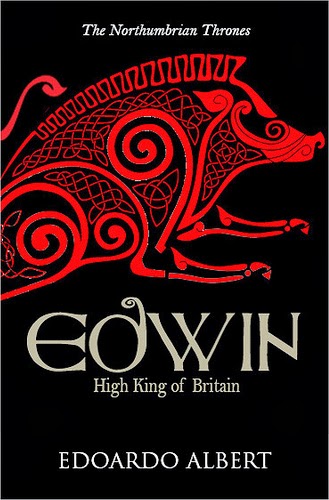
It’s only taken me thirty-two years to get to this stage! Anyway, Edwin: High King of Britain was a result of the research that went into writing my book, Northumbria: the Lost Kingdom, on the history and archaeology of one of the key Dark Ages kingdoms of England (although, of course, England didn’t actually exist then). The story of the three successive Northumbrian kings whom the Venerable Bede accords the title bretwalda – that is High King of Britain – seemed so extraordinary I was astonished that nobody had written about them before. So I decided to.
One of the advantages of doing things this way round was that I had already done most of the historical research necessary – it was just a matter of trying to bring it all to life. Hopefully I have done so, it would be a grave discourtesy to some extraordinary but all but forgotten people if I haven’t. The book will be published by Lion Fiction in March. The publishers, spotting a link, have given the trilogy the overarching title of The Northumbrian Thrones but in truth, there really was something very like a game for thrones going on in the bloody, violent but extraordinarily creative kingdoms of seventh-century Britain. The foundations of England were laid, amid historical darkness, in a time when the only certainty for a king was a violent death. And yet, perhaps because of the very precariousness of the times, these men and women created things, such as the Lindisfarne Gospels and the Sutton Hoo jewellery, of quite extraordinary beauty. While in some ways the kings of the Early Medieval Period (the preferred academic term today) were like Mafia dons, enforcing protection rackets on their subjects, yet the culture they created and their sensitivity to language were as far removed from the profane and profanity filled life of a John Gotti as it is possible to be.
To do such times and such people justice is no small task. I can hardly hope to have succeeded, but at least I hope not to have failed.
Edoardo Albert is, on paper at least, a surprisingly exotic creature: Italian, Sinhala and Tamil by background, he grew up in London among the polyglot children of immigrants (it was only when he went to university that he actually got to know any English people). He avers that he once reduced a reader to helpless, hysterical laughter. Unfortunately, the piece that did so was a lonely-hearts ad.
Find Edoardo Albert’s books (he’s particularly proud of Northumbria: The Lost Kingdom) and stories via his website although the lonely-hearts ad will not be making an appearance in the foreseeable future. Connect with him through his blog, Twitter or Facebook.
In honour of Penumbra’s second birthday, and without the slightest (well, hardly) intention to ingratiate myself with its editors, may I say that this is undoubtedly the friendliest and most professional magazine I’ve dealt with. Penumbra pays well, looks marvellous, responds quickly and, apart from publishing my stories, provides me with this free soapbox to advertise myself and my wares. What’s not to like? And, more importantly, long may it continue, particularly if it publishes more of my stories.
Dianna Gunn, intern par excellence, asked me to write something about what I’ve been up to since appearing in the magazine (since you ask, the Revolution and Exploration issues) and it just so happens that I have my first novel due out next March.
It’s only taken me thirty-two years to get to this stage! Anyway, Edwin: High King of Britain was a result of the research that went into writing my book, Northumbria: the Lost Kingdom, on the history and archaeology of one of the key Dark Ages kingdoms of England (although, of course, England didn’t actually exist then). The story of the three successive Northumbrian kings whom the Venerable Bede accords the title bretwalda – that is High King of Britain – seemed so extraordinary I was astonished that nobody had written about them before. So I decided to. One of the advantages of doing things this way round was that I had already done most of the historical research necessary – it was just a matter of trying to bring it all to life. Hopefully I have done so, it would be a grave discourtesy to some extraordinary but all but forgotten people if I haven’t. The book will be published by Lion Fiction in March. The publishers, spotting a link, have given the trilogy the overarching title of The Northumbrian Thrones but in truth, there really was something very like a game for thrones going on in the bloody, violent but extraordinarily creative kingdoms of seventh-century Britain. The foundations of England were laid, amid historical darkness, in a time when the only certainty for a king was a violent death. And yet, perhaps because of the very precariousness of the times, these men and women created things, such as the Lindisfarne Gospels and the Sutton Hoo jewellery, of quite extraordinary beauty. While in some ways the kings of the Early Medieval Period (the preferred academic term today) were like Mafia dons, enforcing protection rackets on their subjects, yet the culture they created and their sensitivity to language were as far removed from the profane and profanity filled life of a John Gotti as it is possible to be.
To do such times and such people justice is no small task. I can hardly hope to have succeeded, but at least I hope not to have failed.
Edoardo Albert is, on paper at least, a surprisingly exotic creature: Italian, Sinhala and Tamil by background, he grew up in London among the polyglot children of immigrants (it was only when he went to university that he actually got to know any English people). He avers that he once reduced a reader to helpless, hysterical laughter. Unfortunately, the piece that did so was a lonely-hearts ad.
Find Edoardo Albert’s books (he’s particularly proud of Northumbria: The Lost Kingdom) and stories via his website although the lonely-hearts ad will not be making an appearance in the foreseeable future. Connect with him through his blog, Twitter or Facebook.
Subscribe to:
Posts (Atom)